
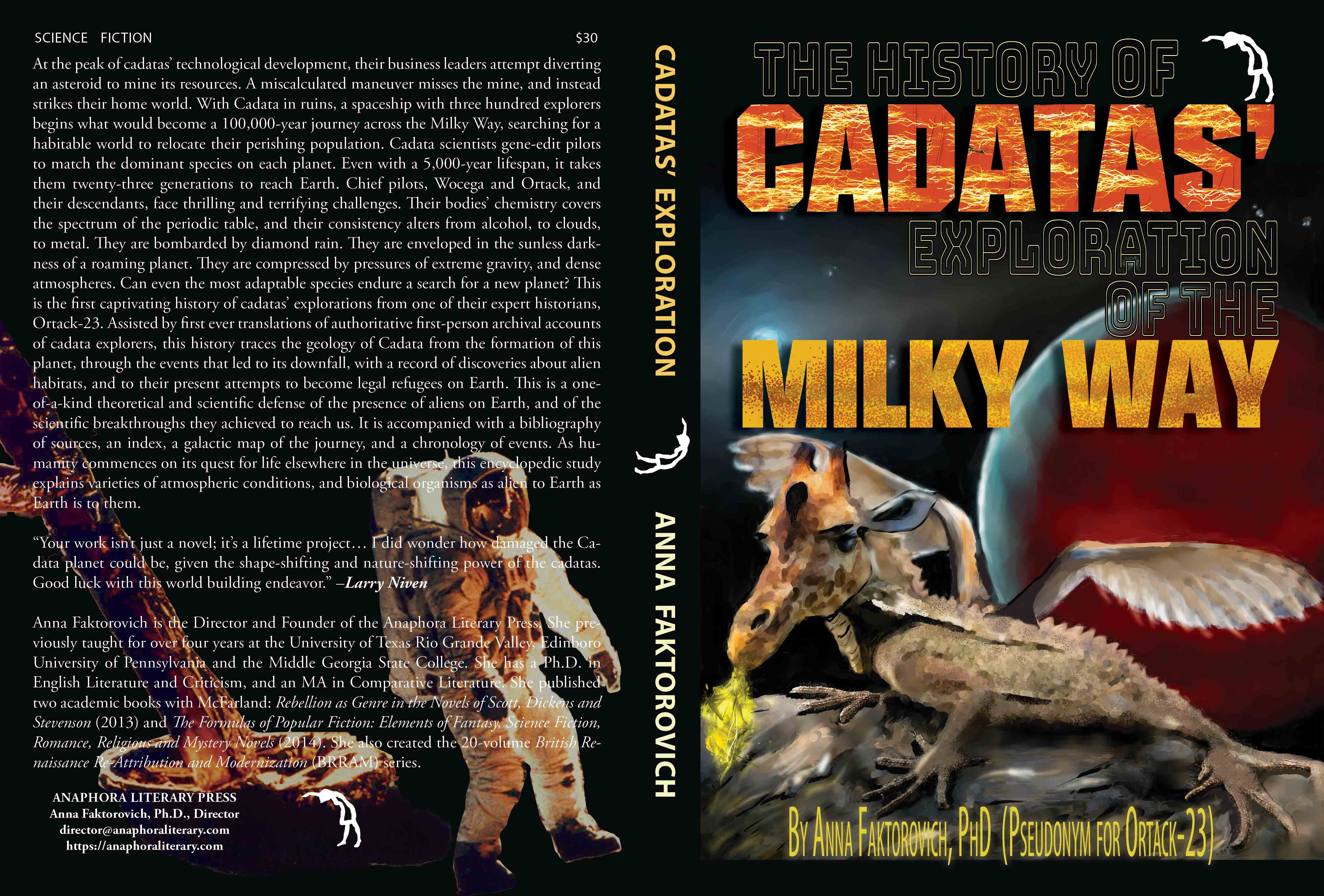
The History of Cadatas’ Exploration of the Milky Way: (Softcover: $30, 392pp, 7X10”: 978-1-68114-611-9; Hardcover: $35: 978-1-68114-612-6; Kindle: $9.99; EBSCO/ProQuest Ebook: 978-1-68114-617-1: $9.99; Google Play Audiobook: $9.99; LCCN: 2024946203; Science Fiction & Fantasy—Science Fiction—Hard Science Fiction; September 1, 2024): At the peak of cadatas’ technological development, their business leaders attempt diverting an asteroid to mine its resources. A miscalculated maneuver misses the mine, and instead strikes their home world. With Cadata in ruins, a spaceship with three hundred explorers begins what would become a 100,000-year journey across the Milky Way, searching for a habitable world to relocate their perishing population. Cadata scientists gene-edit pilots to match the dominant species on each planet. Even with a 5,000-year lifespan, it takes them twenty-three generations to reach Earth. Chief pilots, Wocega and Ortack, and their descendants, face thrilling and terrifying challenges. Their bodies’ chemistry covers the spectrum of the periodic table, and their consistency alters from alcohol, to clouds, to metal. They are bombarded by diamond rain. They are enveloped in the sunless darkness of a roaming planet. They are compressed by pressures of extreme gravity, and dense atmospheres. Can even the most adaptable species endure a search for a new planet? This is the first captivating history of cadatas’ explorations from one of their expert historians, Ortack-23. Assisted by first ever translations of authoritative first-person archival accounts of cadata explorers, this history traces the geology of Cadata from the formation of this planet, through the events that led to its downfall, with a record of discoveries about alien habitats, and to their present attempts to become legal refugees on Earth. This is a one-of-a-kind theoretical and scientific defense of the presence of aliens on Earth, and of the scientific breakthroughs they achieved to reach us. It is accompanied with a bibliography of sources, an index, a galactic map of the journey, and a chronology of events. As humanity commences on its quest for life elsewhere in the universe, this encyclopedic study explains varieties of atmospheric conditions, and biological organisms as alien to Earth as Earth is to them.
“Your work isn’t just a novel; it’s a lifetime project… I did wonder how damaged the Cadata planet could be, given the shape-shifting and nature-shifting power of the cadatas. Good luck with this world building endeavor.” –Larry Niven
Anna Faktorovich is the Director and Founder of the Anaphora Literary Press. She previously taught for over four years at the University of Texas Rio Grande Valley, Edinboro University of Pennsylvania and the Middle Georgia State College. She has a Ph.D. in English Literature and Criticism, and an MA in Comparative Literature. She published two academic books with McFarland: Rebellion as Genre in the Novels of Scott, Dickens and Stevenson (2013) and The Formulas of Popular Fiction: Elements of Fantasy, Science Fiction, Romance, Religious and Mystery Novels (2014). She also created the 20-volume British Renaissance Re-Attribution and Modernization (BRRAM) series.
Table of Contents
Preface
The Editor, Ortack-23, summarizes this study’s research methodology. This book follows the standard Earth formula for an academic textbook. He also reports on the current terraforming experiments he is performing on Mars.
Introduction
Ortack-23 reports biases and falsehoods in human narrators’ depictions of aliens. He corrects these misconceptions with science and philosophy. An overview describes cadatas’ natural physiology, explaining their biological capacity to mutate form, and to glide through the air.
Chapter 1: The Rise of Cadata’s Culture and Science
This chapter runs through Cadata’s evolutionary tree, pre-history of cadatas, and their more recent history. The elements of Cadata’s natural climate help to explain how cadatas have reacted to different alien environments. Like Earth, Cadata has an archeological record. This documented evidence is used to support the narrative of Cadata’s pre-history. Cadatas’ first sculptural language, and the formation of early cadata societies clarify cadatas’ nature, and how they came to have the characteristics modern cadatas exhibit. The history describes the major ages of cultural, and political development of Cadata, covering the Mineral-Manipulation Age and the Nutritional Gas Shortages War. During the Scientific Innovation Age, cadatas developed their construction methods, holographs, and other advanced technologies. The formation of the Smartness Agency became necessary as technology alleviated tensions that erupted in the Near-Thousand-Year War. The Smartness Agency has a mandate to find culprits in criminal activity; however, it seldom succeeds, as it still refuses to change its tactics. In the Millennial Age, cadatas expanded their lifespans to 5,000 years. The Age of Progress was characterized by development of absurdist and nonsensical arts. This Age ended abruptly when an island patronizing many of these artists was incidentally flattened.
Chapter 2: The Dimensions of the Disaster
When the association of Potentates, or the oligopoly’s small group of mega-corporation leaders attempts to attract a mineral-rich asteroid to Cadata to mine it, this maneuver’s execution fails. Instead of commencing an orbit around Cadata’s moon, it hits Cadata. The devastation caused by this impact is described. Cadatas had been experimenting with space travel prior to this impact. Initially, extensive space-travel was judged to be unhealthy because it tended to lead to psychosis in isolated pilots. With the death toll at half of the planet’s population and rising, the Potentates are forced to approve plans to develop a spaceship capable of taking hundreds of cadatas on a journey in search of a new planet to inhabit.
Chapter 3: The Long Journey to Liftoff
The bureaucratic hurdles that prevented an immediate implementation of a space-travel program are described. Before deciding on a spaceship, other proposals for terraforming, and more galactically-proximate solutions are considered. Cadata scientists expand their field of planetary astronomy until it can estimate planetary environments prior to commencing a journey towards a potentially habitable destination. An aside philosophizes on the nature of civilization superiority, with a review of the absurdities of the gluttony-bias in Earth scientist Kardashev’s scale of civilizations. Then, the history of Cadata’s development of hyper-developed robots, with the role they played in causing catastrophic events that followed. It took thousands of years for cadatas to transition from planning a mission outside their solar system to solving the logistic challenges. Scientists were already capable space-travel in theory at the onset. Lift-off was instead delayed by the bureaucratic processes impeded by corruption, bribery, and incompetence among business and government leaders, and general intoxication. Finally, funds are approved, and a spaceship is built for the first major voyage outside cadatas’ solar system, to a planet called Ganeir. Different types of spaceship engines are cataloged, with the reason why cadatas chose the one designed to recycle and appropriate accessible space matter and energy within reach during flight. The methods and approaches to gene-editing cadatas to take the appearance of species on alien worlds.
Chapter 4: The Exploration of Ganeir
Cadatanauts undergo intense prolonged space-travel training within cadatas’ solar system to test equipment, intelligence, and flight strategies. Biographies and contributions of the major cadatanauts, scientists and administrators responsible for the mission. Putair Niatage, the lead cadatanaut for the mission, describes the training he underwent to fly to Ganier in first-person diary entries. Putair is a prankster, who disrupts training for others in the class, while managing to excel. Putair details their unexpectedly elongated flight to Ganeir, despite succeeding at traveling at near-light-speed, and the tragic end their mission came to. Then, the last diary entry from their Head Doctor, Wern Lexause, details the horrific disease they were infected with on Ganier that killed the entire cadatanaut crew. Editor Ortack-23 explains how the sterilized spaceship returned itself to Cadata.
Chapter 5: The Start of the Long Voyage Across the Milky Way
Nally Subsenar, the lead founder of the interstellar exploration mission, pushes for adjusting systems for the mission to be capable of exploring multiple solar systems. She designs the necessary adjustments to the spaceship for this. New training methods and disaster-avoidance subroutines are incorporated to avoid a repetition of the Ganeir disaster. Nally joins the spaceship on this adjusted mission herself because Cadata’s environment is becoming progressively uninhabitable.
Chapter 6: Water World
The method for researching a new world during a slow-down approach as part of a safe landing protocol. Cadatanauts near Nerore: a water world. Nanobots fly ahead and gather genetic materials and data necessary for the preparatory biological experiment. A gene-edited cadatanaut attempts living in a cloned artificial environment on the Mothership that simulates life on Nerore. Lead Cadatanaut Wocega Lapovy describes what it felt like to transition to an under-water lifeform from a cadata in her diary entries. Wocega narrates the dangers of landing a shuttle into a turbulent ocean. She begins eating, drinking, and socializing in accordance with local customs. While Wocega is busy incorporating into the culture, she passes a cadata disease to neroreans, who die in enormous numbers from it. She is reprehended by authorities, who spot her alien identity, and question her about the alien invaders causing this new disease. Cadatas stage a dramatic rescue to extract Wocega from this interrogation. However, the team decides to begin a journey to the next potentially-habitable planet in the Catalog. There was no hope cadatas could have reestablished peaceful relations with neroreans after this medical calamity.
Chapter 7: Alcohol-Based Lifeform
Concerned about the pattern of two planets in a row showing cadatas’ arrival tends to generate disease outbreaks, the science team develops strategies to prevent this obstacle. Their next stop is to an alcohol-based world, where the lifeforms are innately alcoholic. The habits and science of this species reflect this drunken biology. The planet, Likos, has various other unique features, including being located close to a relatively dim M-star. Cadatas land on this planet’s moon, where they wait for Cega to perform a standard visitation experiment to Likos in a likos-biology-cloning gene-edited body. She catches fish, and learns the locals’ laughing language. Cega’s assessment is that likos are too volatile for cadatas to attempt settling on their planet. Cadatas agree, and continue their journey.
Chapter 8: Hot Diamond Rain
A new generation of cadatanauts is sent to explore Nomuat, a planet so hot that it undergoes daily diamond rain showers. Nomuat is also blanketed in extreme aurora displays, and other shocking natural features due to its unique environment. The species has an incredible halogen composition, capable of tolerating this extreme heat, and other hellish Nomuat elements. A submissive species on this planet is being exploited for their labor. The cadatanauts are tricked into surrendering an enormous volume of treasures to a local fraudster, who they take to court. They lose the case, remaining uncompensated because, as foreigners, they lack property rights. A group of aliens even attempts to steal cadatas’ Mothership. This potentially mission-ending theft is prevented because exposure to the cadata-centric environment on the Mothership causes the thieves to turn to stone. Cadatanauts decide to seek a less ultra-hostile planet.
Chapter 9: A World Without Sunshine
Without the capacity to identify the psychological characteristics of alien lifeforms, cadatas yet again meet with an ultra-aggressive species on their next stop at Ragile: a very cold planet. Wocega-6 struggles with this species’ incommunicability, as she adjusts to living within its biology. Ragile’s populations have been isolated into isolated lakes. The equilibrium among them is interrupted through access to cadatas’ technologies, which enable them to travel between lakes. Instead of using this access to expand knowledge, they begin warring over power. These conflicts eventually make Ragile uninhabitable for cadatas.
Chapter 10: Life Among the Clouds
Cadatas explore Nefo, and its species of cloud-dwelling lifeforms. As a gas planet, it can only support gaseous life in this unique state. Wocega-8 describes transforming into an incorporeal being. The nefos are mind-controlled by their empresses into performing labor for the ruling class. Wocega-8 joins the court of one of these empresses as an assistant, describing the misadventures she has in her diary. Unhappy with the mind-control aspect, cadatas attempt to free nefos from this influence. However, the liberated nefos choose to entirely escape civilization’s controls, swinging Nefo into continuous chaos, thus forcing cadatas to begin yet another migration.
Chapter 11: A Planet Sailing Through Deep Space
Cadatas spend 5,375 years at light-speed to arrive at Bhasab, a roaming planet flying through interstellar space because it has been tossed out of its initial solar system by its sun’s interaction with a black hole. Wocega-9 transforms into the local tree species, initially finding it difficult to adjust to moving extremely slowly. Then, she finds life among the trees to be meditative, and has a series of adventures with her tree friends. In one incident, she encounters fire-starting trees, who her adopted-clan fights with in response to the destruction they cause to others in that region. Things take a turn for the worse when Wocega-9’s cadata shuttle is found and examined, leading to the bhasabs developing a new, hyper-destructive, tree-burning vehicle model. This tree-guzzler rapidly consumes Bhasab’s forest resources, sinking the planet into an environmental crisis. Not knowing how to stop this catastrophe, cadatas move on to the next potential world.
Chapter 12: Rival Species on Neighboring Worlds
The drastic downfall of Bhasab causes psychological damage to the second generation of cadatanauts who were stationed there. Wocega-10 has a breakdown causing her to kill the mission doctor, and then to commit suicide by jumping out of the spaceship mid-flight. Failing to learn from Wocega-10’s philosophical suicide note, cadatas then arrive in a system with two proximate worlds: Pallos and Byddwr. Two cadatas undergo a transformation into the dominant species of these worlds. Wocega-12 is sent on a water-covered world called Byddwr, while Ortack-12 is sent to the freezing world of Pallos. The peaceful-minded, docile species’ world has been conquered by the war-mongering Pallos. Byddwr has been forced to produce the goods Pallos survives on. Wocega-12 enjoys the hard labor she endures on Byddwr, in part because it involves ballooning for transport. Meanwhile, Ortack-12 enjoys the intense physical exercise of hunting with his local mentors. Then, Ortack-12 commits the crime of complaining, and is put on an unjust trial meant to solicit bribes from those accused, instead of acting as a reforming punishment. Ortack-12 spies on his hosts to discover an advanced sect of pallos, who have been swaying planetary events. Cadatas’ bribe-negotiations with these pallos fail, forcing the Mothership to accelerate to the next target world.
Chapter 13: Are Two Suns Better than One?
The Eekalah solar system has two suns, which cause several environmental abnormalities for this planet. Wocega-14 is sent to explore it. She finds a single eekalah species, which became dominant through their runaway consumption of all plant- and animal-equivalent rivals. They then became cannibals, fighting each other to survive. Training to join them required Wocega-14 to survive extreme feats of endurance in anticipation of having malicious killers as neighbors. She strove to discover a method for turning the eekalahs away from cannibalism, when suddenly the two suns in that system triggered an explosive nova reaction. As cadatas escape this devastation to the remaining life on Eekalah, they question if cadata researchers might have caused the acceleration of these two stars’ nearing.
Chapter 14: Life Among the Metalloids
Ahutababha is an eccentric planet populated by metalloids. Wocega-16 encounters an ice storm during her initial landing. Beyond undergoing standard gene-editing, Wocega-16 faces the challenge of being forced to tremendously expand her body weight to enter ahutababhas’ natural hibernation cycle. Surviving this prolonged sleep requires reaching a specified weight, or the organism will die during the following starvation period. Most ahutababhas are extremely impoverished, and barely survive these winters. A few rich ahutababhas own giant skyscrapers, which exclusively house them, and an enormous military that exists to prevent the poor from rebelling against this system. Wocega-16 joins impoverished villagers in scavenging for food after they awake from hibernation. Wocega-16’s village life is further complicated by a poisonous smog, and then a powerful cyclone. Cadatas attempt to fix the planet’s eccentricity by artificially pulling it into a steadier orbit. However, this backfires, causing a social planetary disaster, and warfare.
Chapter 15: Metal in the Genes
The next planet, Miotail, houses metal-based lifeforms in an extremely hot environment. The miotails began their evolution as robotic assistants to biological lifeforms. They technologically advanced themselves to be more life-like across millions of years. Then, their planet became uninhabitable for biological life, while the miotails continued to evolve. Wocega-18 undergoes an irreversible transformation into one of these robot-like lifeforms. There is a debate about the ethics of killing her biological essence to make her into an eternally-operating machine. The miotails welcome cadatas, and offer a thorough explanation of their history and science. It is a friendly dialogue. However, as they watch Wocega-18 live as a miotail, the other cadatas decide they cannot follow her example by undergoing this transformation. Perpetual life is an insufficient substitute for the loss of organic life. This eliminates Miotail as a long-term habitat, and cadatas are forced to proceed to their next potential planet.
Chapter 16: The Tiny Creatures with Mighty Muscles
On Bulshiyket, a massive gas giant, the cadata science team discovers tiny creatures capable of withstanding 250g force with the strength of their extraordinary muscles. Wocega-21 does not transition into these, or other Bulshiyket lifeforms, when cadatas discover they received an erroneous intelligent-life signal from this system. If intelligent-life has not evolved in Bulshiyket’s conditions; there are no suitable intelligent organisms for cadatas to mutate themselves into. The team researches this curious environment for lessons on how an extremophile organism can survive under such pressure, before pressing on.
Chapter 17: The Earth Mission
Editor Ortack-23 describes his own life, which begins amidst cadatas’ journey to Earth. During an asteroid-mimicking de-acceleration, and then disguised steady flight, cadatas begin to learn about uncanny human behaviors, biology, and cultures. Cadatas explore major planetary, moon, comet, asteroid and solar bodies in Earth’s Solar System, reporting some contradictory findings to Earth scientists’ conclusions. Ortack-23 is sent to perform a full-spectrum analysis of the potential habitability of Mars. Nurry Loody-23 is sent to explore the geology and habitability of Venus, including performing small-scale terraforming experiments, and a base-installation in its natural climate. Wocega-23 mutates into a human. She is given a Blackbird super-speed human-plane-mimicking shuttle. On Earth, she commits fraud, and other crimes to purchase enormous properties needed to hide her alien identity during her scheduled adaptation experiments. These gigantic purchases of islands and other luxuries does the opposite, triggering investigations and forcing her move into less conspicuous housing. When Wocega-23 loses communication with the rest of the scattered cadata fleet, she gene-edits her body to gain the appearance of a female astronaut scheduled to make a trip to the Space Station, to take this trip in her place. From space, she briskly repairs the broken cadata equipment. However, she struggles with completing the assigned human-astronaut tasks. The human technical problems with the shuttle, and the Station terrify her, until she can endure no more, and pushes away from the Station into space, where fellow cadatas snatch her into their camouflaged alien shuttle. The astronaut Wocega-23 was imitating returns to Earth, where conspiracy theorists suspect she was kidnapped by aliens. Wocega-23 continues her research into humanity. When all experiments confirm Earth is ideally suitable for cadatas’ settlement, cadatas face the strange problem of how they could legally immigrate to Earth. An honest confession on immigration forms of their alien background would be interpreted as a science fiction joke, or a deranged delusion. Lying by inventing a human origin-narrative would be problematic because of the need to maintain a generations-long conspiracy to avoid discovery. At the time of this history’s composition, cadatas are still searching for ways to overcome these challenges.
Chronology
Cadatas’ chronological pre/history provides clarity among the leaping dates across a narrative that covers hundreds of thousands of years.
Bibliography
Bibliography of human and cadata textbooks and monographs cited across this book.
Index


 Anaphora Literary Press
Leave a comment