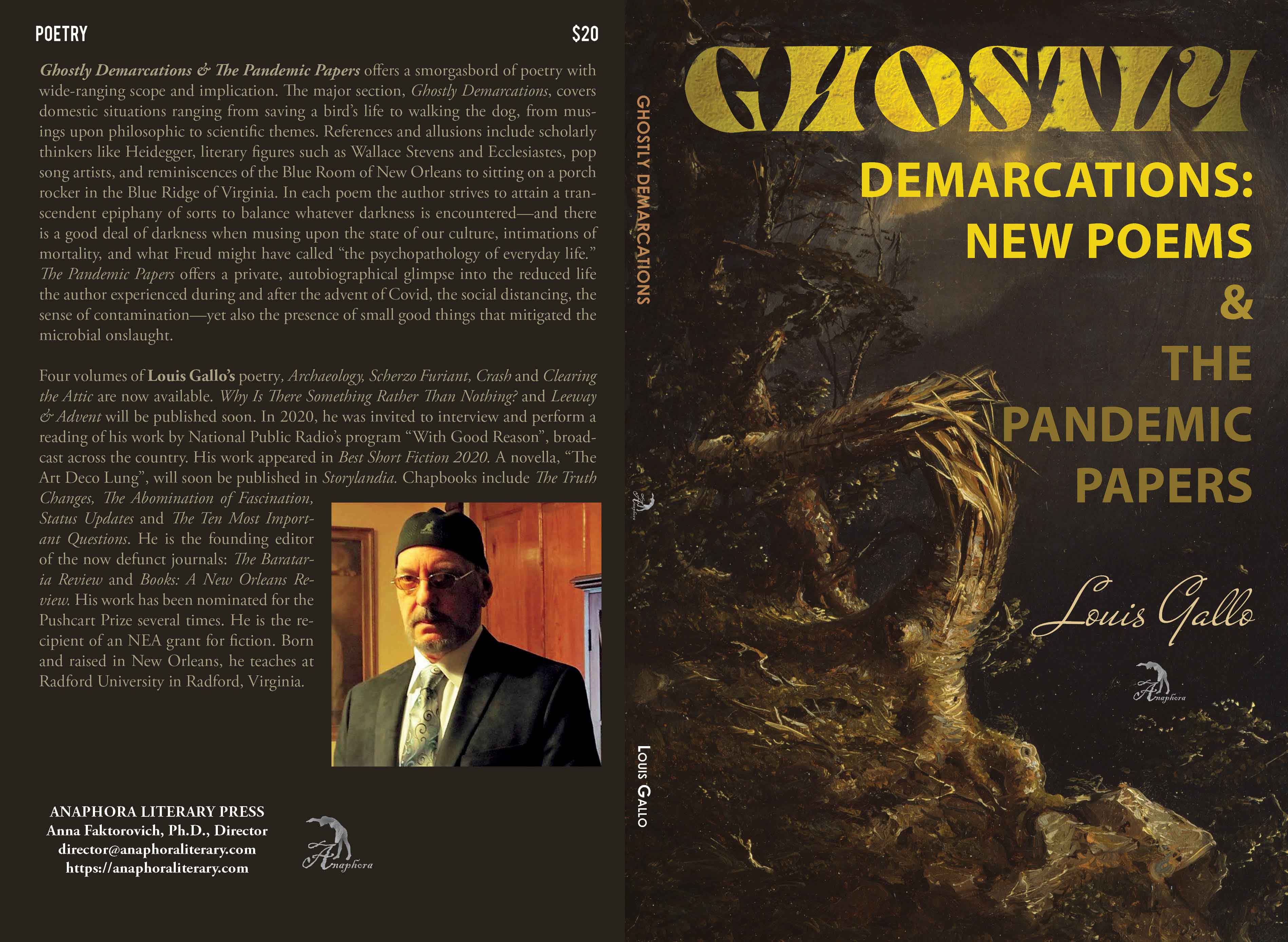
Ghostly Demarcations: New Poems & The Pandemic Papers (Softcover: $20, 158pp, 6X9”: ISBN: 979-8-385676-31-6; Hardcover: $25: ISBN: 979-8-385676-55-2; Kindle: $2.99; LCCN: 2023904116; Nonfiction—Poetry—Subjects & Themes—Nature; Release: March 15, 2023; Click on links to purchase on Amazon): offers a smorgasbord of poetry with wide-ranging scope and implication. The major section, Ghostly Demarcations, covers domestic situations ranging from saving a bird’s life to walking the dog, from musings upon philosophic to scientific themes. References and allusions include scholarly thinkers like Heidegger, literary figures such as Wallace Stevens and Ecclesiastes, pop song artists, and reminiscences of the Blue Room of New Orleans to sitting on a porch rocker in the Blue Ridge of Virginia. In each poem the author strives to attain a transcendent epiphany of sorts to balance whatever darkness is encountered—and there is a good deal of darkness when musing upon the state of our culture, intimations of mortality, and what Freud might have called “the psychopathology of everyday life.” The Pandemic Papers offers a private, autobiographical glimpse into the reduced life the author experienced during and after the advent of Covid, the social distancing, the sense of contamination—yet also the presence of small good things that mitigated the microbial onslaught.

Flash Gardens, and Other Short Fiction (Volume One): (Paperback: $20, 176pp, 6X9”: ISBN: 978-1-68114-599-0; Hardcover: $25: ISBN: 978-1-68114-600-3; Kindle: $2.99; LCCN: 2023912938; Literature & Fiction—Literary Fiction—Short Stories; Release: July 14, 2023; Purchase on Amazon): This first volume of Flash Gardens compiles short fictional pieces by the author, written over a span of years and mostly all published in journal and magazines in both America and abroad. The author contends that all poetry and fiction is autobiographical in the sense that experience filters through an individual mind and must therefore reflect the wisdom or ignorance of that mind as well as temperamental quirks, psychological issues, philosophical biases and breadth of knowledge. This is nothing new—the so-called New Journalism of the sixties and seventies made a similar point: because reportage is interpreted by individual minds, “objectivity” is an illusion (example—the work of Hunter Thompson). Hence, in some way, whatever the occasion or subject matter, the fiction in Flash Gardens represents the impressions and “takes” of the author, whether the subject matter involves genuine physical experiences or musings upon science or psychological dilemmas.
The locale of the stories shifts mostly between places the author has known well either by living within or visiting—mainly New Orleans and southwest Virginia. The characters are almost inevitably people the author knows and has known, with proper fictional alterations. The tone of the stories varies wildly, from acute sentimentality to the aforementioned illusion of objectivity. But their overwhelming climate seems melancholy (tempered often by dashes of humor) that involves an aching sense of loss and nostalgia for the past. And why not? Our sense of the “present moment” lasts about only two hundred milliseconds, which means that the past constitutes our entire identities, while the “future” is too diffuse to fathom.
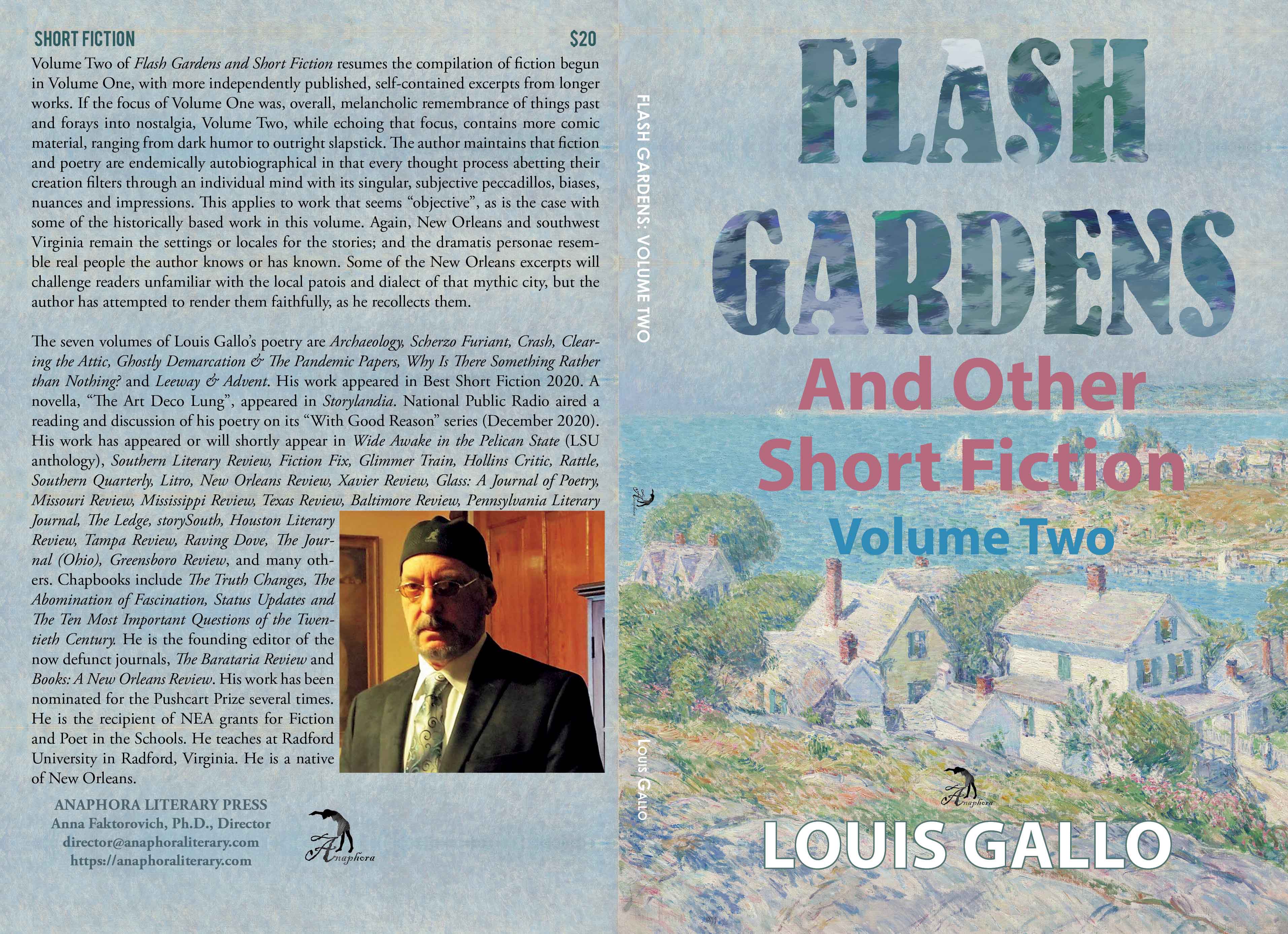
Flash Gardens, and Other Short Fiction: Volume Two: (Softcover: $20, 192pp, 6X9”: ISBN: 978-1-68114-601-0; Hardcover: $25: ISBN: 978-1-68114-602-7; Kindle EBook: $2.99; LCCN: 2023912938; Books—Literature & Fiction—Humor & Satire—Dark Humor: Short Stories; Purchase on Amazon): Volume Two of Flash Gardens and Short Fiction resumes the compilation of fiction begun in Volume One, with more independently published, self-contained excerpts from longer works. If the focus of Volume One was, overall, melancholic remembrance of things past and forays into nostalgia, Volume Two, while echoing that focus, contains more comic material, ranging from dark humor to outright slapstick. The author maintains that fiction and poetry are endemically autobiographical in that every thought process abetting their creation filters through an individual mind with its singular, subjective peccadillos, biases, nuances and impressions. This applies to work that seems “objective”, as is the case with some of the historically based work in this volume. Again, New Orleans and southwest Virginia remain the settings or locales for the stories; and the dramatis personae resemble real people the author knows or has known. Some of the New Orleans excerpts will challenge readers unfamiliar with the local patois and dialect of that mythic city, but the author has attempted to render them faithfully, as he recollects them.
The seven volumes of Louis Gallo’s poetry are Archaeology, Scherzo Furiant, Crash, Clearing the Attic, Ghostly Demarcation & The Pandemic Papers, Why Is There Something Rather than Nothing? and Leeway & Advent. His work appeared in Best Short Fiction 2020. A novella, “The Art Deco Lung”, appeared in Storylandia. National Public Radio aired a reading and discussion of his poetry on its “With Good Reason” series (December 2020). His work has appeared or will shortly appear in Wide Awake in the Pelican State (LSU anthology), Southern Literary Review, Fiction Fix, Glimmer Train, Hollins Critic, Rattle, Southern Quarterly, Litro, New Orleans Review, Xavier Review, Glass: A Journal of Poetry, Missouri Review, Mississippi Review, Texas Review, Baltimore Review, Pennsylvania Literary Journal, The Ledge, storySouth, Houston Literary Review, Tampa Review, Raving Dove, The Journal (Ohio), Greensboro Review, and many others. Chapbooks include The Truth Changes, The Abomination of Fascination, Status Updates and The Ten Most Important Questions of the Twentieth Century. He is the founding editor of the now defunct journals, The Barataria Review and Books: A New Orleans Review. His work has been nominated for the Pushcart Prize several times. He is the recipient of NEA grants for Fiction and Poet in the Schools. He teaches at Radford University in Radford, Virginia. He is a native of New Orleans.
“Louis Gallo’s poems are intellectually charged units of voltage (voltage, one of Gallo’s recurrent images, along with wishbones and cupcakes) yet always accessible, always challenging us to think in new ways about commonplaces we all take for granted. The primal tone of Gallo’s poetry is cosmic melancholy tempered with bursts of Proustian privileged moments, the anti-voltage of nostalgia sweetened with the hope of wishbones, the sweetness of cupcakes. Reading this collection straight through is indeed one of those privileged moments.”
—Justin Askins, author of Neversink, In Search of the Wild and Changing Terra
“Louis Gallo is a poet who is finely tuned to actualities with the ability to exhibit them from unexpected angles. Each poem arrests the attention of the readers in a way to make us stop and reflect on these intense experiences. With brilliant precision, the poems engage the readers to balance between the poet’s sympathetic perception of earnest human condition and subtle humor.”
—Kristina Kočan, author of (Šara, 2008; Kolesa in Murve, 2014; Šivje, 2018) Maribor, Slovenia
“Francis Bacon famously said that he took all knowledge to be his province. So does Louis Gallo. Behind his poems lies a voracious intellect, one that draws upon a dazzling array of major thinkers —Wittgenstein, Aristotle, Plato, Freud, Descartes, Einstein, Camus—to name only a few. But reliant as he is on such colossi of often abstract, complex ideas, his poems first and foremost are always anchored with keen wit in the grit and gristle of a living world, one Gallo—clearly finds both intoxicating and erotic.”
—Randall Freisinger, Author of Plato’s Breath and Windthrow & Salvage
“These are the mature poems of a tireless observer, a person of intense, articulated feeling, one who has remained an eager and fascinated student way beyond the call.”
—Ralph Adamo, editor of The Xavier Review, author of Ever


 Anaphora Literary Press
Leave a comment