
The Magazine
Editor: Anna Faktorovich, PhD
Have you speculated regarding why most popular science fiction and fantasy magazines are closed to new submissions, while their subscription numbers are dwindling? Then, you would agree this is the moment in Earth’s timeline that demands a new entrant into this potentially mind-stimulating category. Let us bravely redefine the term “speculative” as not something conjectured unknowingly. Instead, a speculation should be a well-researched guess about mysterious subjects touching either on future or past scientific discoveries. To not meekly fly into formulaic tropes that position fairies against knights, but instead engineer mystical supernatural worlds that enrich human mythology by adding unheard of fantastical creatures, types of magic, and philosophical substance. The Golden Age of science fiction could not have ended a century ago, unless this phrase refers to the decades when magazines in this genre made the greatest pile of money. It is as important for modern speculative writers to prove our best fiction is in our future, as to prove humanity’s best science is ahead. Otherwise, we are sliding backwards into the Dark Ages, while regurgitating Bosch’s Earthly Delights. If you sympathize with this mission; either contribute to, or subscribe to Speculative.
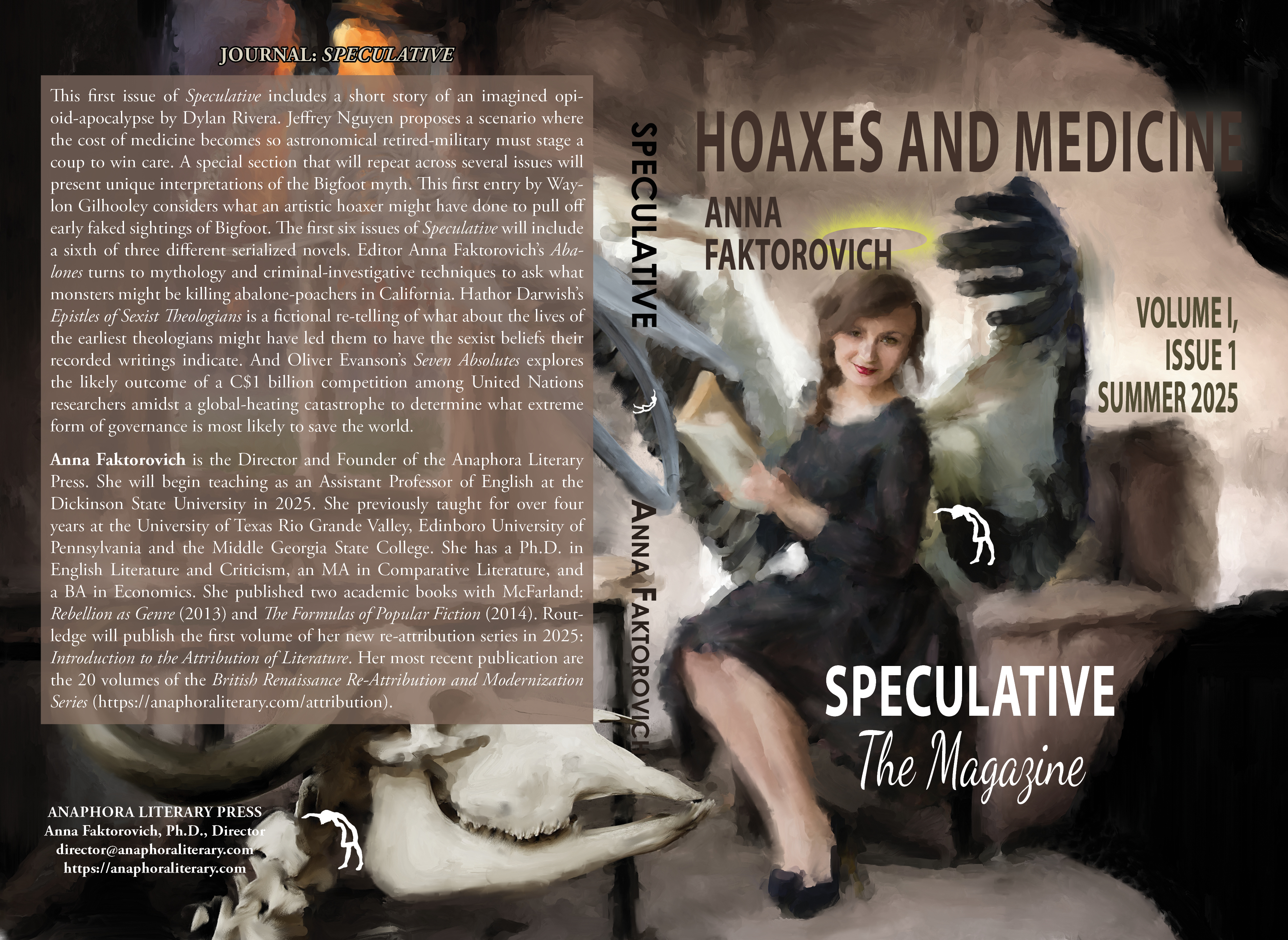
Hoaxes and Medicine: Volume I, Issue 1, Summer 2025: (Softcover: ISBN: 979-8-297056-15-2: $20: 166pp, 6X9”; Hardcover: ISBN: 979-8-297056-34-3: $25; Purchase on Amazon):This first issue of Speculative includes a short story of an imagined opioid-apocalypse by Dylan Rivera. Jeffrey Nguyen proposes a scenario where the cost of medicine becomes so astronomical retired-military must stage a coup to win care. A special section that will repeat across several issues will present unique interpretations of the Bigfoot myth. This first entry by Waylon Gilhooley considers what an artistic hoaxer might have done to pull off early faked sightings of Bigfoot. The first six issues of Speculative will include a sixth of three different serialized novels. Editor Anna Faktorovich’s Abalones turns to mythology and criminal-investigative techniques to ask what monsters might be killing abalone-poachers in California. Hathor Darwish’s Epistles of Sexist Theologians is a fictional re-telling of what about the lives of the earliest theologians might have led them to have the sexist beliefs their recorded writings indicate. And Oliver Evanson’s Seven Absolutes explores the likely outcome of a C$1 billion competition among United Nations researchers amidst a global-heating catastrophe to determine what extreme form of governance is most likely to save the world.
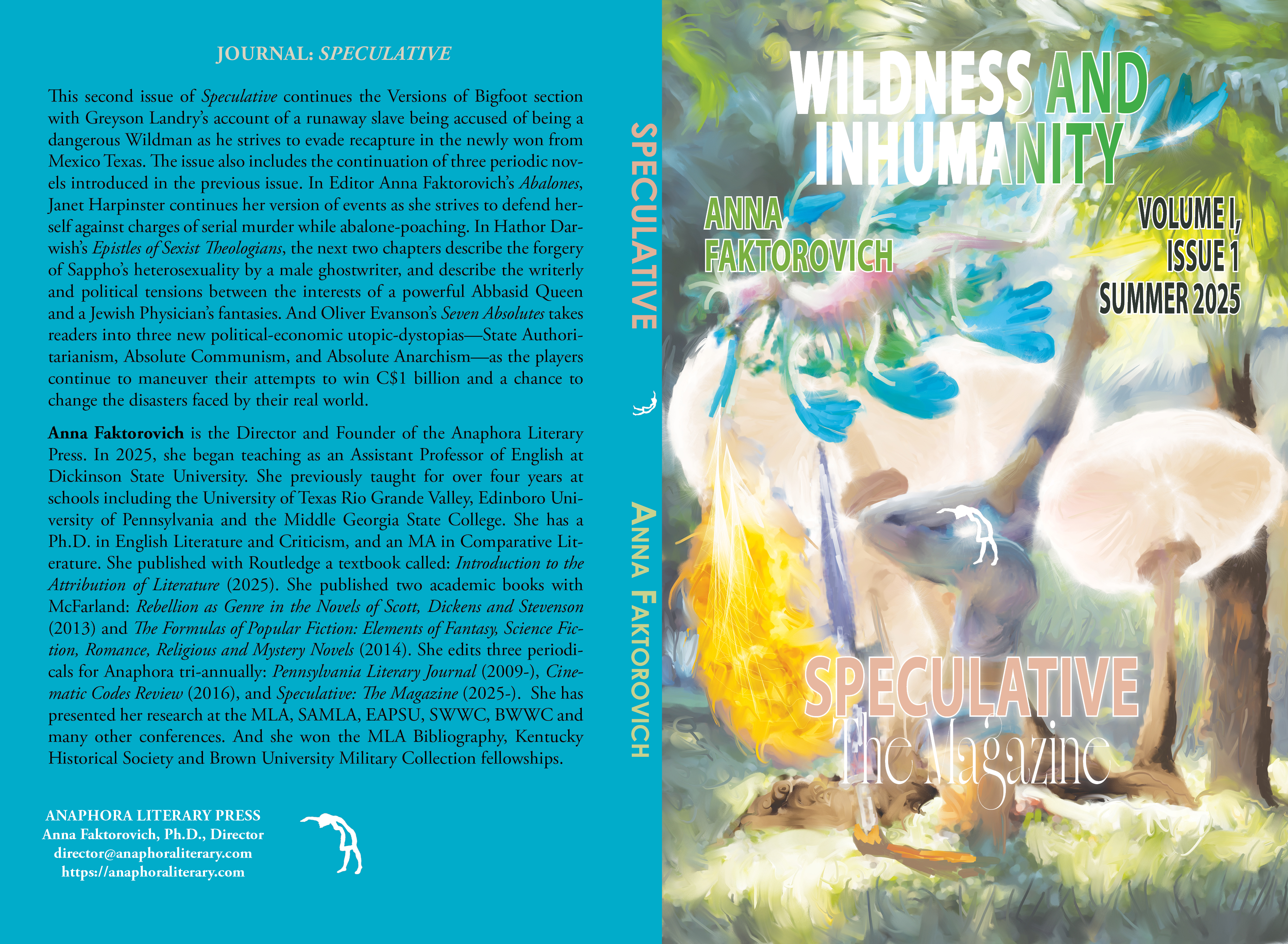
Wildness and Inhumanity: Volume I, Issue 2, Fall 2025: (Softcover: ISBN: 979-8-241286-37-6: $20: 148pp, 6X9”; Hardcover: ISBN: 979-8-241286-51-2: $25; Purchase on Amazon):This second issue of Speculative continues the Versions of Bigfoot section with Greyson Landry’s account of a runaway slave being accused of being a dangerous Wildman as he strives to evade recapture in the newly won from Mexico Texas. The issue also includes the continuation of three periodic novels introduced in the previous issue. In Editor Anna Faktorovich’s Abalones, Janet Harpinster continues her version of events as she strives to defend herself against charges of serial murder while abalone-poaching. In Hathor Darwish’s Epistles of Sexist Theologians, the next two chapters describe the forgery of Sappho’s heterosexuality by a male ghostwriter, and describe the writerly and political tensions between the interests of a powerful Abbasid Queen and a Jewish Physician’s fantasies. And Oliver Evanson’s Seven Absolutes takes readers into three new political-economic utopic-dystopias—State Authoritarianism, Absolute Communism, and Absolute Anarchism—as the players continue to maneuver their attempts to win C$1 billion and a chance to change the disasters faced by their real world.




 Anaphora Literary Press
Leave a comment