Tag Archives: donald-trump

Voter vs Ohio County Board Choosing Primary Substitute in a Closed Meeting

26 Oct

Can a county Board of Elections choose a substitute candidate in a closed meeting? This was the central question in The State ex rel. Koebel v. Erie County Board of Elections et al debated in the Ohio Supreme Court. It was filed by a voter who demanded the removal of a Republican replacement candidate from the shortly forthcoming November 2026 general election ballot. While the court agreed this voter’s claims had legal standing, they objected that his 25-day delay in filing this lawsuit meant that they were now beyond the point when ballots could be changed without extremely wasteful costs. Overseas and military ballots had already been mailed starting on September 18. And rewriting and reprinting 36,450 physical ballots was deemed to be too costly.

Events began on August 4, when D.J. Swearingen won the Republican primary but then withdrew from the general election. On August 10, a Republican Party district committee met behind closed doors and chose Caleb Stidham as their replacement nominee. The filer of this lawsuit is a regular voter, Carl Koebel, who tried to gain entry to this meeting, but was denied entry. Koebel has argued that the closure of this meeting to the public meant this committee took upon themselves to perform an illegal (by Ohio’s Open Meetings Act) sovereign governmental function. Then, on August 20, the Erie County Board of Elections reached a 2-2 tie to certify Stidham that had to be broken by Secretary of State Frank LaRose in favor of Stidham’s certification. Koebel’s petition for removal was filed on September 14.

The outcome of Koebel’s filing was that the court reaffirmed the Ohio precedent that any voter has a beneficial interest to sue an election board to force their performance of statutory duties. However, Koebel’s delay invalidated the filing, meaning the court did not have to decide on if the nomination violated the Open Meetings rule. A minority of judges—Justice Brunner and Chief Justice Kennedy—had wanted to vote on the merits despite the tardiness.

According to Ohio’s procedural rules, when a nominee withdraws, the replacement is made by a district committee made up of county party leaders. Political parties are private organizations that can hold closed meetings to choose a replacement candidate. An exception has developed in Ohio after Jones v. Geauga County Republican Party Central Committee (2017) that decided that whenever a private party meets to fill a public government vacancy it is performing a “sovereign governmental function”, and this falls under the Open Meetings Act. The 2017 case had addressed the appointment of vacancies such as county commissioner or sheriff, whereas this latest case is about appointing a county party nominee. Thus, this could have been an interesting case for the court to address if it would not have been wasteful to engage in debate at the cost of complicating and spiking the cost of an ongoing election.

Though the more interesting question nobody has asked is: why are parties private? Why are a few unelected people gathering in closed rooms to decide who the public is allowed to vote on? Though America is more democratic than other countries in some regards. Elsewhere, political parties are also private, and they privately select their candidates, whereas in the U.S. the public votes in primary elections to instruct these private institutions who they should forward as their candidate. Though even if slightly more democratic, the private party system invites antidemocratic corruptions. The voters should see some list of positions of all candidates on issues they care about and click to pick how they side on the issues to choose a candidate. Or better yet, true democracy would mean voters logging into a national voting system and voting separately on each item a representative would otherwise vote over on their behalf. Directly choosing to go to war or not, or what government funds should be spent on would override many of the problems we face when representatives’ votes can be bought by interested corporations, foreign entities, or other actors.

Suggested Citation:
Faktorovich, Anna. “Voter vs Ohio County Board Choosing Primary Substitute in a Closed Meeting.” Anaphora’s Law Review (October 26, 2026).
86% of Maine’s Voters Banned Foreign Election Interference, Before CMP’s Money Reversed Their Decision

24 Oct

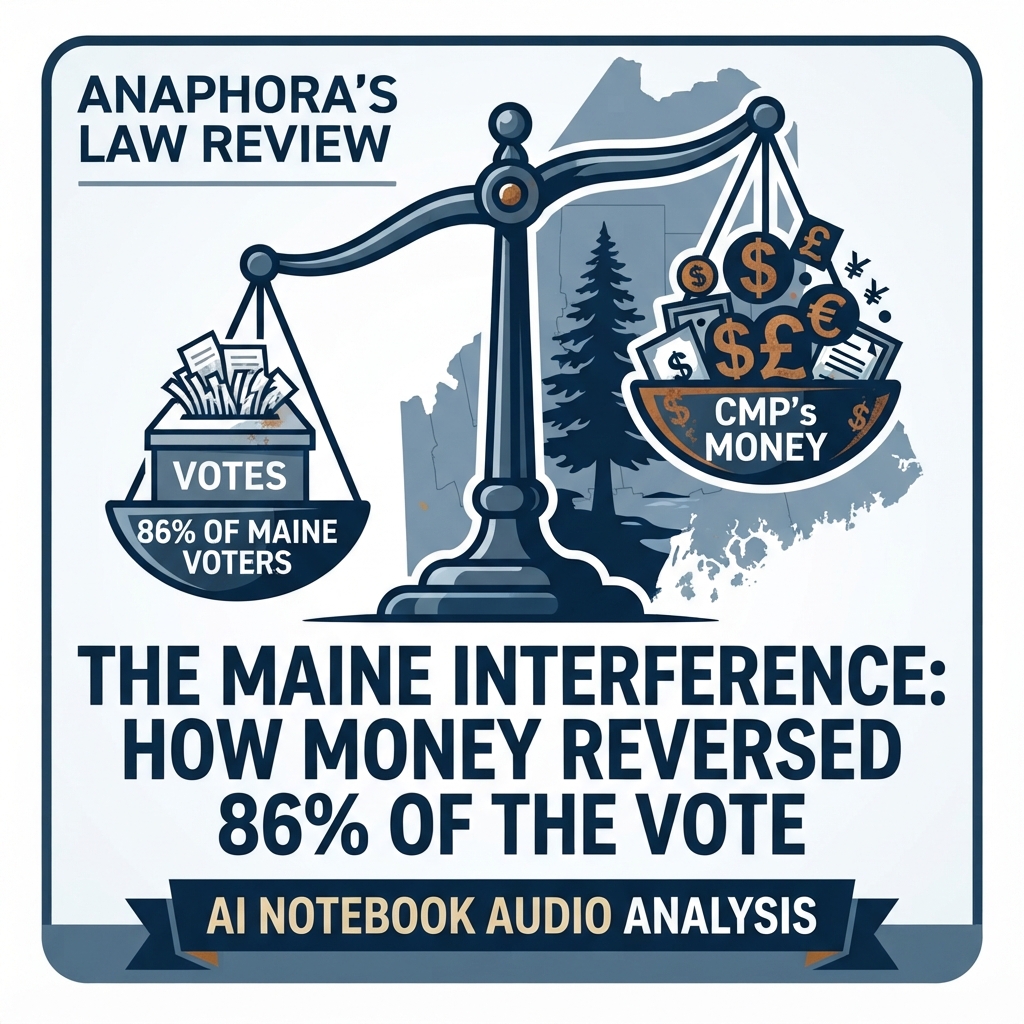
In Central Maine Power Company (CMP), et al. v. Maine Commission on Governmental Ethics and Election Practices, et al., the United States District Court for the District of Maine granted motions to allow CMP to continue donating to political candidates by declaring two portions of Maine’s new campaign finance law unconstitutional, but denied motions regarding the remainder of the statute, allowing the rest of the law to survive through legal severance.

The first element the court objected to in the law is the 5% corporate foreign ownership rule, arguing that this was too small of a share, and that only a controlling shareholder should be significant enough to exclude a corporation’s influence over elections. The second point was over if a foreign government “directly or indirectly participates in the decision-making process” over elections spending. The court interpreted the latter as possibly merely meaning a foreign government had consulted a corporation, even if this corporation was fully owned by American shareholders.

According to OpenSecrets, CMP and its parent company Avangrid have largely spent money on ballot referendums. By donating over $35 million to the Maine Affordable Energy PAC, they defeated a referendum that would have forced a consumer buyout of the utility grid. And they spent tens of millions to defend their referendum for a hydropower transmission line through western Maine.

Maine passed a ballon initiative restricting Foreign Government-Influenced Entities (FGIE) back in 2023. The Act could apply a $5,000 civil penalty or double the amount donated. They could no longer spend on elections, and their public communications had to carry mandatory disclosures of foreign-influence. It also applied a new burden onto media companies to check if block ads that failed to meet these disclosure rules. Because of this lawsuit, this law was blocked on the eve it was going to go into effect. This stillborn law had passed by a historic 86% margin. The law had been led by the nonpartisan Protect Maine Elections, and democracy reform groups such as American Promise and Maine Clean Elections. And Free Speech for People and Campaign Legal Center have filed amicus briefs arguing the 5% limit is a globally recognized threshold. Though most democracies, such as France, Canada, Japan and South Korea, completely ban corporate political contributions: foreign and domestic. Thus, there limit is 0%. After the 2010 Supreme Court Citizens United ruling that allowed unlimited spending on elections by American corporations, U.S. states and cities have begun applying the 5% threshold to at least limit foreign spending.

Aside from Maine, there was also a failed attempt to implement foreign spending limits in Minnesota. The only state where a spending limit is currently being enforced is in Washington, which uses the controlling-share limit, as opposed to the 5% cutoff. The only places in the U.S. that have a 5% limit being enforced are the cities of Seatle (2020-) and San Jose (2024-).

Leading up to and after Citizens United, there has been systematic campaign to corrupt U.S. elections by arguing that corporations have a First Amendment right to “speak” with unlimited campaign contributions. Since the 2016 election of Donald Trump had been judged by oversight agencies to have been interfered in by foreign actors—especially Russia—this wave of attempts to counteract America’s slide into unbridled corruption could have given some hope, if it had not been repeatedly quashed by moneyed interests. Corporate donations had been banned in the U.S. by the 1907 Tillman Act. Because corporations reacted by attempting to donate indirectly, a few acts—between 1947 and 2002—followed that further limited activities, such as requiring that corporate employees could only donate indirectly into Political Action Committees (PACs). Citizens United reversed this march towards democratic representation. If CMP had not been able to block the Pine Tree Power buyout, Maine taxpayers would have taken on $13.5 billion in debt to buy the utility, but could have been rewarded with improved reliability and a lower electricity cost. And while the NECEC corridor added tons of energy to the grid, it clear-cut pristine northern Maine woods (undercutting tourism and wildlife) to bring power to Massachusetts. The point of democratic referendums is to invite voters to decide which among such choices they care most about. When 86% of Maine’s voters voted against foreign interference, and a corporation with these foreign influences could buy their way into winning a lawsuit to reverse the voters’ decision, this is an extreme case of anti-democratic voting-system suppression.

Suggested Citation:
Faktorovich, Anna. “86% of Maine’s Voters Banned Foreign Election Interference, Before CMP’s Money Reversed Their Decision.” Anaphora’s Law Review (October 24, 2026).