Tag Archives: history

Brazil’s Odebrecht Continues Corrupting the Judicial Process to Evade Restitution

29 Oct

Norberto Odebrecht was founded in Brazil in 1944, and gradually expanded to become an international civil engineering giant. Then, in 2016, it signed a global leniency agreement in Brazil and pled guilty in the U.S. federal court to systemic bribery committed between 2001-16 and paid billions in criminal fines. In 2006, Odebrecht had institutionalized their bribing operations by running them through a new Division of Structured Operations. During the years investigated, Odebrecht had paid around $788 million in verified bribes to secure more than 100 large-scale projects across 12 countries, including the 2016 Olympic Games projects in Brazil, pipelines, and transit.

A year after Odebrecht pled guilty, in 2017, a civil lawsuit was filed in the Southern District of New York by claiming to be securities defrauded investor Washington State Investment Board (WSIB) over its $100 million loss in bonds. It faced an obstacle in 2020, when Judge Paul G. Gardephe dismissed a part of WSIB’s initial complaint because WSIB had not provided details on which financial statements were distorted by bribe amounts. In 2021, a second major civil lawsuit that had been brought by investor DoubleLine was obstructed by the granting of an order shielding Odebrecht’s communications from private investigators, seemingly to protect active foreign investigations. Then, in a 2023, amended complaint, WSIB fixed the glitch that previously derailed them by linking $280 million in bribes to specific distorted corporate assets: this finally convinced Judge Gardephe to lift his discovery stay and to allow WSIB to demand corporate records. Then, WSIB attempted to ask for a summary judgement based on the criminal finding of fraud, but Magistrate Judge Barbara Moses rejected this idea and asked them to litigate the case anew civilly. While the court had allowed litigants to begin asking for discovery years earlier, Odebrecht had not been complying with these requests, and in September 2026, it attempted to formally block all discovery by claiming Brazil’s Supreme Court had dismissed their leniency agreement due to prosecutorial misconduct.

In the latest development in WSIB v. Odebrecht S.A., Judge Moses ruled against Odebrecht, arguing Brazilian squabbles cannot be employed to prevent American civil discovery. The court is now deciding if the parties will proceed by Odebrecht actually opening themselves to discovery scrutiny, or if they will begin settlement negotiations.

It has been a decade since Odebrecht confessed and opened their files to Brazilian prosecutors, and yet after a decade of attempts from investors to be compensated they have not been able to begin a case because the “details” of how Odebrecht was defrauding them is hidden in he files Odebrecht is refusing to turn over. Without access to the evidence, the prosecutors cannot prove the thing they know the evidence would logically state, based on what the criminal pleading indicates.

Only now is the U.S. court even beginning to rule on the irrationality of Odebrecht’s objections: Brazilian law cannot bar them from disclosing the facts of their briberies. Their leniency agreement was designed to protect the criminal Brazilian investigators, not the books that prove the corruption of executives, operators or investors of Odebrecht. The change that prompted this sudden renewal of litigation activities is that the Brazilian Operation Carwash has concluded back in 2021 (after 278 convictions and the recovery of $800 million), and these investigators have made public the facts in the accounts recording the briberies, and their depositions about them (released back in 2017). Thus, records are now public, even if Odebrecht continues refusing to surrender these records. The reason for a decade-long stall is partially clarified by the finding of illegal collusion between Chief Judge Sergio Moro and the prosecutors in Operation Carwash in Brazil, which have led to the Brazilian Supreme Court’s annulling of most of this operations convictions and fines due to misconduct. These absurdly stumbling trials are themselves evidence of Odebrecht’s ongoing successes at corrupting the criminal and civil judicial processes. Odebrecht is still an active company, with annual revenues that have dropped to around a billion from a peak of $30 billion pre-scandal. It is the vulture investors who anticipated Odebrecht’s “sudden” or artificially orchestrated legal collapse in 2016 who made a lot of money, and it might be their accounts that Odebrecht has been fighting to protect from implication. They also made a windfall when the Supreme Court refunded Odebrecht’s apparently temporary corruption fines.

This case proves that following-the-money is not possible without hacks when the sued party corrupts the system into blocking the legal opening of their books. And in such cases of billions-worth-in-corruption, there are no good guys. Even the 2019 Intercept uncovering of messages between Carwash prosecutors and Judge Moro showing a coordination of strategies served to reverse the criminal findings, instead of bringing new charges against the exposed judge and prosecutors. Perhaps, anti-corruption investigations are doomed to be corrupted? Who can resist bribes with billions on-offer? Across the decades the bribery and the failed lawsuits have been happening the Workers’ Party has been mostly in charge. Luiz da Silva, who just won a fourth term in October 2026, was the president between 2003-10, followed by Workers’ Party’s Dilma Rousseff (2011-6), before Rousseff was impeached and removed from office. Operation Carwash’s prosecutors had argued that the Workers’ Party was running the pay-to-play ring that Odebrecht was merely a player in. There was a claim that Lula secretly owned a house that Odebrecht and another construction company had spent over $200,000 remodeling, among other “gifts”. These accusations convinced Judge Moro to convict Lula of corruption and money laundering, for which he spent 580 days in federal prison. The 2019 Intercept leak found evidence against Judge Moro and annulled Lula’s conviction. This is why Lula could run for office yet again, and has just won. And Lula has been crushing his opponents through the courts, including convicting Jair Bolsonaro of attempting a coup d’etat for plotting a violent overthrow to overturn his failed 2022 election run. And immediately after Senator Flavio Bolsonaro lost the most recent 2026 election Lula targeted him with multiple criminal investigations over money laundering (via links to a sports-betting corporation), raising money from a financier for a film about his father, and securing campaign financing from U.S. conservative donors. And now Flavio has illegally (despite his passport being seized in Brazil) escaped into the U.S., where he has been granted visas by Trump. There are no good guys in this story, but it is a dramatic and captivating saga.

Suggested Citation:
Faktorovich, Anna. “Brazil’s Odebrecht Continues Corrupting the Judicial Process to Evade Restitution.” Anaphora’s Law Review (October 29, 2026).
No Surprises Invites Doctors to Sue en Masse for Higher Payments

28 Oct

Since the bipartisan No Surprises Act (NSA) went into effect on January 1, 2022, there has been a flood of lawsuits by providers over insurance underpayments. NSA bans surprise out-of-network bills for patients, including by out-of-network providers working at in-network hospitals. It also caps patient costs to standard in-network cost-sharing amounts (copay, coinsurance, and deductibles). And NSA shifts responsibility over disputes from patients to a negotiation between insurance and medical providers working through independent arbitrators. The element cluttering the courts now (with hundreds of thousands of cases filed by providers against insurers) is that NSA does not include a “private right of action” that would allow doctors to sue insurers in federal court over skipped payments. Without this wording, federal courts have been dismissing an avalanche of filed direct federal enforcement suits.

Without this right, insurers have been taking defensive actions such as not paying the fair amount even after the federal Independent Dispute Resolution (IDR) votes against them. Instead of pursuing a losing strategy, providers such as Dr. Jonathan Nissanoff have been finding loopholes such as California’s quantum meruit and Unfair Competition Law (UCL).

Nissanoff v. Blue Shield of California (2026) began when Dr. Nissanoff performed an emergency orthopedic service to a Blue Shield enrollee. After submitting this case to the insurer, Nissanoff determined Blue Shield’s initial payment was “substantially below the reasonable and customary value” for such procedures. Dr. Nissanoff filed an IDR complaint under NSA and it determined on September 17, 2024 in favor of Dr. Nissanoff, ordering Blue Shield to pay an adjustment amount of $56,623.40 for the services. Blue Shield refused to pay this full sum, so this case moved forward in a state court to force Blue Shield to cover to award. Only the equitable and California UCL pars of the lawsuit survived, while the claims under NSA (impossible to enforce decisions of IDR), Knox-Keene Act (does not apply to private parties), common law contracts and ERISA (failure to plead administrative exhaustion) were dismissed.

Doctors never have time to check insurance before an emergency procedure, so testing the law in this case is relevant for many similar cases. And Dr. Nissanoff’s claim specifies that this is not an isolated case, but rather that in his experience Blue Shield has demonstrated a pattern of “lowballing initial payments, forcing IDR, and refusing to honor the results.” It is absurd that the current law forces an arbitration process, but lacks a firm recourse for the winners of this process to enforce what the process decides.   Insurers are succeeding in avoiding following a bipartisan decision for them to bill fairly by unfairly refusing to grant sums judged to be fair. An Act of Congress can made the decisions of IDR legally enforceable with an amendment to NSA by adding wording specifically granting a private right of action or a streamlined confirmation process. Though according to the Center on Health Insurance Reforms, there have been 2.6 million IDR disputes filed by providers in 2025 alone (77% increase). Providers win in around 90% of cases. If all of these wins are enforceable, insurers might have to drastically raise their rates. Are doctors really asking for the fair rate, or are they asking for as much as possible? Since America’s medical industry is already costing Americans more than twice the second-highest paying country (Switzerland), if these costs climb still higher because of a law that tips the scale in favor of doctors pressuring for maximum payouts, the public might end up losing. The rational solution to keeping costs low is for arbitrators to enforce a qualifying payment amount (QPA) or a median per-procedure in each geographic region to keep costs steady. But following these median rates has been prevented by litigations against this barrier.

Suggested Citation:
Faktorovich, Anna. “No Surprises Invites Doctors to Sue en Masse for Higher Payments.” Anaphora’s Law Review (October 28, 2026).

Squabbles Over “Genuine” Signatures vs Stopping Israel-U.S. War Profiteering

28 Oct

In Alan H. Peres and Piergiorgio Uslenghi v. The Municipal Officers Electoral Board for the Village of Oak Park, et al. (2026), the Illinois Appellate Court affirmed that a public referendum petition substantially complied with the Illinois Election Code, rendering it valid despite an accidental omission of the explicit statutory phrase certifying that the signatures “are genuine.”

The proponents are Caren Van Slyke and Jesse Simon Bauer, who circulated a petition to this village’s residents to put a question before their voters in the upcoming November 3, 2026 ballot: “[s]hould the State of Illinois repeal laws that ban state investment in businesses that boycott the State of Israel?” This petition obtained 3,504 signatures from undisputed registered voters. But then Alan H. Peres and Piergiorgio Uslenghi filed an objection to this petition at the Oak Park Electoral Board to prevent this question from appearing on the ballot by arguing the certification statements on these petition sheets were defective by failing to specify these signatures were “genuine”. The words of the certifying statement is a paraphrase of the standard language, which specifies the person signing is a “qualified elector”, but does note specifically the signatures were not forgeries. The court ruled that this deviation was insubstantial, or that the wording that was included met the intent of the requirement to include this certifying language.

Justice Pucinski delivered the judgement, arguing the statement served the intended purpose of validating the identity of the signers. Denying the rights of the signors on this technicality would have unjustly denied their voting rights. Justice Hyman dissented, arguing the allowance of a substitution of “presence” for “genuineness” changes this legislative mandate, inviting more creative rewordings in the future.

The distance this miswording has gone in the courts almost suggests somebody intentionally inserted this mistake to attempt to disqualify this referendum if it succeeded in finding enough signatures. And the investment in covering court fees by the filers indicates they were overly interested in reversing what so many in their village wanted to vote on. And wasn’t there a bigger problem in the wording of the referendum question itself: why would it be logical to ban investments in the businesses operated in Israel, as opposed to banning investments in its government? Isn’t it directly antisemitic to boycott all Israeli businessmen? Though blocking the businesses of countries with whose leaders American politicians disagree is a standard, as seen in the ongoing blockade of Cuba.

Boycotting countries is typically within the federal jurisdiction. Some city councils or state legislative bills have handled such boycott requests. There has been a unique movement to divest from Israel via local ballots, like the one that passed in Somerville, Massachusetts and Providence, Rhode Island. The latter referendum referred to foreign countries engaged in severe violations of human rights, as opposed to Israel specifically. There have not been any statewide referendums to boycott Israel. States have moved in the opposite direction, with 37 states passing binding anti-BDS laws or executive orders that have penalized or banned contracting with businesses that are publicly boycotting Israel.

The movement to boycott Israel is not entirely strange, as during Apartheid in the 1970-80s dozens of U.S. cities, universities and state legislatures voted to divest public funds or pensions from companies doing business in South Africa. On the federal level, the Sudan Accountability and Divestment Act of 2007, authorized state and local governments to divest from companies operating in Sudan’s power, mineral or oil sectors. And the U.S. Office of Foreign Assets Control (OFAC) orchestrates economic embargos or business-blocking for countries on the Department of State’s “State Sponsors of Terrorism” blacklist, which includes Cuba, Iran and North Korea. Since the start of the war after the terrorist attack in October 2023, Israel’s economy has been surging (by 130% in the Tel Aviv stock market), despite a drop in its labor force due to the mobilization of reservists and a leveling of tourism and construction (due to fears related to the war). The major economic hit has been the $114 billion in debt Israel’s government has taken on to wage this war. The U.S. has spent around $33 billion on this conflict. Thus, if Americans believe this war can be ended by draining Israel’s military budget, U.S. would logically stop spending money on this war on the U.S. end and would stop giving military aid to Israel. But the U.S. has instigated wars with Iran, Iraq, Afghanistan, and other countries in the Middle East, so it is not merely aiding Israel but rather is pushing Israel into perpetual conflict. The problem is perpetual warmongering: wars are too profitable for the companies selling the tools of war for them to allow federal blockades. And the U.S. might have to label itself as a terrorist state, if it puts Israel on this list, given their joint operations that have put Israel on international human rights violation lists.

Suggested Citation:
Faktorovich, Anna. “Squabbles Over “Genuine” Signatures vs Stopping Israel-U.S. War Profiteering.” Anaphora’s Law Review (October 30, 2026).

A First Win for Activists Challenging DOJ’s Right to Investigate Non-Criminals

27 Oct

The Oregon Court of Appeals has reversed a trial court’s dismissal of Farrell-Smith v. Oregon Department of Justice. The plaintiffs are suing the Oregon Department of Justice (ODOJ), the Attorney General, and the Chief Counsel of ODOJ’s Criminal Justice Division over their questionable authority to operate a domestic intelligence unit called the Oregon TITAN Fusion Center: Terrorism Information Threat Analysis Network. This is one of many nationwide intelligence hubs developed by the U.S. Department of Homeland Security to assess or anticipate threats post-9/11. The plaintiffs allege that TITAN surveils politicians and activists based on their views, instead of on any suspected criminality: and this is outside TITAN’s executive mandate.

Plaintiffs have presented evidence TITAN routinely monitors activists that oppose the Jordan Cove Liquified Natural Gas Pipeline, without a “criminal nexus” for these investigations. TITAN is also improperly colluding with a private PR firm (Teneo) and a pipeline-funded sheriff’s unit to gather information while bypassing Freedom of Information Act (FOIA) requirements. Privacy is also being violated when TITAN applies software to track on social media those who use the Black Lives Matter hashtag. And plaintiffs object to ODOJ’s secrecy in blocking public scrutiny and media record requests about demonstrations (i.e., Women’s March) by invoking broad “criminal intelligence” exemptions.

The trial court rejected the case partly because it interpreted the lawsuit as a request to shut down TITAN, whereas the Court of Appeals adjusted this aim to this being a challenge to the legality of TITAN’s cited operations. The case is asking: is it legal for a government agency to collect intelligence on citizens despite a lack of a suspicion of criminality? The appellate answer is that ODOJ is bound by the powers Oregon has assigned to it, or investigating: organized crime, public corruption or searching for investments of criminally implicated funds. Investigating outside these boundaries means TITAN is acting without a legal mandate. TITAN attempted to defend its actions by using loosely related laws, such as ORS 181A.250 that is inapplicable because it prohibits the collection of data based on political, religious or social views. The court rejected that obtaining a grant or a letter of acknowledgement from Governor Kitzhaber gave TITAL a special mandate.

There have been several federal lawsuits by civil liberties groups making FOIA requests to expose DHS-supported fusion centers spying on non-criminals. For example, a 2008 FOIA request revealed the Maryland Coordination and Analysis Center (MCAC) had investigated anti-death penalty and peace groups; the outcome of litigation was forcing the dismantling of the research files MCAC had gathered. And in 2025, ACLU v. Department of Justice was dismissed after a FOIA request succeeded in proving FBI’s Joint Terrorism Task Force and DHS fusion centers were investigating non-criminals by grouping radical causes with minorities and “domestic terrorism”. This Oregon case is a first state litigation that challenges the legality of such agencies to investigate non-criminals, as opposed to merely seeking FOIA data that this illegal surveillance exists. Legal scholars hope that if this Oregon case continues to see positive outcomes, it might help dismantle the 79 fusion centers across the U.S.

The lack of past accountability over these fusion centers might stem in conservatives’ successful attempts to redefine “communism”, “socialism” and other pro-justice and pro-humanist causes as amoral and thus equivalent to illegal. Mis-programmed voters tend to mis-define “communism” as totalitarianism or a lack of individual rights. They have been taught to assume there is something amoral about supporting equal rights for all, including racial and economic rights. It is in the interests of all humans to support other humans, but this re-programming turns this rational goodness into the opposite. The beneficiaries of this reversal are monopolists and pro-totalitarian rulers who prefer to limit rights: the opposite of the stated objective. Fusion centers are a present Big Brother experiment: it is an extreme form of totalitarian socialism of the Soviet variety. If DOJ’s entities are investigating non-criminals for conservatives’ political gains, they are not spending this time investigating the true criminals. Resources are being wasted to support one of two of America’s parties, while letting criminals continue criming to the detriment of us all.

Suggested Citation:
Faktorovich, Anna. “A First Win for Activists Challenging DOJ’s Right to Investigate Non-Criminals.” Anaphora’s Law Review (October 27, 2026).

First Female Black Judge in Tulsa OK Reprimanded for Shouting, Favoritism and Dishonesty

27 Oct

A public reprimand was issued by the Oklahoma Supreme Court against Tulsa County District Judge Sharon Holmes in Investigation of Sharon Holmes (2026 OK 67) for cumulative violations of the Code of Judicial Conduct. Previously, the Council on Judicial Complaints had recommended invoking removal proceedings for “oppression in office”, but the Supreme Court found her actions were merely legal errors and abuses of discretion as opposed to grounds for removal.

The Court did agree with the Council’s findings that Holmes had violated several rules of judicial conduct. 1. Ex parte communications: Holmes held unauthorized private conversations with a criminal defendant in a hallway, and spoke privately with jurors for several minutes (refusing to disclose the substance of this conversation). And she read private emails from incarcerated defendants’ families without filing them or notifying the parties. 2. Failure to disqualify: she did not recuse herself from cases involving such ex parte communications, as well as cases brought by attorneys who had previously represented her. 3. Sentencing violations: she disregarded statutory sentencing restrictions by allowing ineligible defendants to plead into a specialty treatment docket (Arise Program) without making mandatory on-the-record findings. 4. Undignified demeanor: she demonstrated a pattern of hostile courtroom behavior, including screaming at an assistant public defender in a hallway (as opposed to during a trial) and left the bench to approach an agitated defendant with her firsts raised in a manner that was taken to mean she was preparing to fight them. 5. Lack of candor: her testimony to the Council contradicted evidence, indicating dishonesty.

The Court rejected the Council’s recommendation for removal because they found “oppression in office” (intent to commit acts that are wrong or beyond judicial authority) had not been proven. Two of the justices offered dissenting opinions, recommending a removal trial (Justice Combes), or a suspension without pay (Justice Rowland).

The Council had begun its investigation in June 2025 when they received a complaint of an ex parte communication, and then received additional complaints as they commenced. In the central violation, in open court, a criminal defendant asked to speak with Holmes about a personal matter. Holmes replied that while she could not privately discuss the case, “she would speak to him privately as long as it was alright with his attorney.” It almost seems as if she was set up to make a mistake because neither attorney’s objected in court to this conversation, but then the Tulsa County DA asked for Holmes’ recusal from this case because of it. Holmes refused to recuse herself because this conversation “did not have anything to do with this case, at all.” In the second case where she spoke with jurors, she did recuse herself eventually “in the interest of efficiency to allow the case to move forward quickly.” The Council argued that these brief private conversations were sufficient for her impartiality to be reasonably questioned.

Seemingly, it was certainly unbecoming for her to have shouted at an assistant public defender, but witnesses proved their own hostility when they described her as being “very hostile and very nasty”. This seems to be a case of coworkers and subordinates refusing to accept the authority of a female judge. Accusing her of yelling and being “nasty” seem to be insults designed to minimize her power. It is very difficult for women today to find a “balance” between been powerfully intimidating (as male bosses are to gain leadership positions) and remaining femininely polite while bossing people around.

And observers might have assumed Holmes was obtaining some benefit to bending the rules to send convicts to the Arise Program because it echoes the Kids for Cash scandal from a few years ago that took down for kickbacks (from a for-profit juvenile detention facility) Pennsylvania judges Mark Ciavarella and Michael Conahan.

In contrast, Holmes seems to have been speaking with parties and referring unqualified convicts to a rehabilitation program out of a desire to seem especially helpful. Holmes was first elected to this position back in 2014 as the first Black woman elected as a district judge in Tulsa County. She was an Assistant District Attorney for Tulsa County (2000-3). She won the 2026 reelection by default and is scheduled to remain in her judgeship through at least 2030. Holmes’ approach to mixing bombastic yelling with yielding on talking about personal matters, and being especially kind to some defendants in sentencing has been the reason she had acquired and retained a job no other Black woman had previously climbed into. When judges are elected, they must placate the defendants they see in court to convince the public she represents the interests of the populace poor. Ideally, it would be possible to stop judges from displaying favoritism either because they are being corruptly influenced in a given case or because their reelection depends on them placating some organized criminal group sponsoring their runs. An auditor is unlikely to have witnesses of bribery confessing to having bribed a judge to gain favor. So, they have to rely on appearances of impropriety, of which there were a few in this case. And the problem was not merely that she chatted with jurors, but that she refused to disclose the content of this conversation, which suggested it included inappropriate content she did not want to out. Given these uncertainties and borderline questions, it is a good sign that the Council investigated these allegations, and probably also a good sign that the Court ruled they were not serious enough for the removal of the first female Black judge in this district.

Suggested Citation:
Faktorovich, Anna. “First Female Black Judge in Tulsa OK Reprimanded for Shouting, Favoritism and Dishonesty.” Anaphora’s Law Review (October 27, 2026).

How a “Fantastical” Claim from a “Presidential Candidate” Was Stuck in Pre-Trial for 7 Years Before Dismissal

26 Oct

The common problem in American courts is for cases to be instantly dismissed for a lack of merit due to slight errors made by lawyers, despite their central claims being of significance to the public. The Raysor v. Safi civil lawsuit displays a less common problem: how cases truly without merit clutter the courts’ dockets and thus force judges to reject potentially more weighty disputes.

Events began in November 2017, when officer Troy Ann Safi responded to a domestic dispute in Brooklyn, New York. Ftema Raysor was beating her boyfriend with a hairbrush and biting his ear. Kings County District Attorney dropped criminal charges against Raysor during the initial arraignment process.

Two years later, in November 2019, Raysor filed a federal civil rights complaint pro se in the U.S. District Court for the Eastern District of New York. A year still later, in December 2020, she amended her case by asking for $100 million in damages, and narrowing her claims from many more to two: false arrest and excessive force by Officer Safi. These initial complaints were a standard civil rights complaint hat accused NYPD of false arrest, racial bias and physical assault. Across the following years, Raysor failed to provide discovery on the federal case, while also pursuing a state case.

Finally, on November 12, 2025, the parties submitted a draft joint pretrial order. Then, at the Pretrial on December 29, 2025, U.S. District Judge Diane Gujarati warned Raysor that the witness list she had submitted for this meeting was deficient because she had subpoenaed irrelevant high-profile figures: Donald Trump, a former First Lady, Barack Obama, NYC Mayor Eric Adams, Reverend Al Sharpton and U.S. Senator Markwayne Mullin. At the January 20, 2026 meeting, Raysor’s filing remained noncompliant. So, on February 18, the judge refused to schedule a trial date until Raysor amended her witness list, and the case was referred to court mediation. On June 11, the parties held a video mediation settlement conference before a federal magistrate judge, but failed to reach an agreement. The judge issued another pretrial order on June 18 for Raysor to fix her filing, which she again refused at a July 8 hearing. Finally, on July 21, the city filed a motion to dismiss.

But the case was not immediately dismissed, and instead escalated on August 12-14 when Raysor submitted what the court termed “fantastical” filings that claimed her life was in danger.  In this submission, Raysor explained why she was still insisting on subpoenaing high-profile individuals by stating: “I am running for President of United States of America and was when this event took place my witness are relevant.” She insisted she was refusing “to sit back and let the Law Department kill me.” She refused to cite “cases” because “this is a matter of life or death.” In parallel with these increasingly alarming to the defendants claims, she also set up a protest tent and began living outside the federal courthouse, and began posting photographs and alleged threats against the defense lawyers on YouTube and Instagram. She apparently did indeed register to run as an independent for president in the 2028 election: and this was partly what she was documenting on her social media.

Only after this breakdown—and not immediately afterwards but two weeks later—did Judge Gujarati finally dismiss this lawsuit with prejudice (i.e., without a right to appeal). Did the slowness of the American judicial system drive this filer mad, or did it drive her to the rational solution that instead of subpoenaing presidents she had to run for president to finally obtain some justice? Was she delusional at any point, or is this a woman who succeeded in manipulating judges to keep her case on their docket for a decade? Why was she given such extraordinary number of chances to amend her complaint? Plenty of pro se and public-defender litigants have rational claims rejected on technicalities. This case many lessons to teach us all. But these lessons are too mysterious for a law class.

Suggested Citation:
Faktorovich, Anna. “How a ‘Fantastical’ Claim from a ‘Presidential Candidate’ Was Stuck in Pre-Trial for 7 Years Before Dismissal.” Anaphora’s Law Review (October 26, 2026).

Voter vs Ohio County Board Choosing Primary Substitute in a Closed Meeting

26 Oct

Can a county Board of Elections choose a substitute candidate in a closed meeting? This was the central question in The State ex rel. Koebel v. Erie County Board of Elections et al debated in the Ohio Supreme Court. It was filed by a voter who demanded the removal of a Republican replacement candidate from the shortly forthcoming November 2026 general election ballot. While the court agreed this voter’s claims had legal standing, they objected that his 25-day delay in filing this lawsuit meant that they were now beyond the point when ballots could be changed without extremely wasteful costs. Overseas and military ballots had already been mailed starting on September 18. And rewriting and reprinting 36,450 physical ballots was deemed to be too costly.

Events began on August 4, when D.J. Swearingen won the Republican primary but then withdrew from the general election. On August 10, a Republican Party district committee met behind closed doors and chose Caleb Stidham as their replacement nominee. The filer of this lawsuit is a regular voter, Carl Koebel, who tried to gain entry to this meeting, but was denied entry. Koebel has argued that the closure of this meeting to the public meant this committee took upon themselves to perform an illegal (by Ohio’s Open Meetings Act) sovereign governmental function. Then, on August 20, the Erie County Board of Elections reached a 2-2 tie to certify Stidham that had to be broken by Secretary of State Frank LaRose in favor of Stidham’s certification. Koebel’s petition for removal was filed on September 14.

The outcome of Koebel’s filing was that the court reaffirmed the Ohio precedent that any voter has a beneficial interest to sue an election board to force their performance of statutory duties. However, Koebel’s delay invalidated the filing, meaning the court did not have to decide on if the nomination violated the Open Meetings rule. A minority of judges—Justice Brunner and Chief Justice Kennedy—had wanted to vote on the merits despite the tardiness.

According to Ohio’s procedural rules, when a nominee withdraws, the replacement is made by a district committee made up of county party leaders. Political parties are private organizations that can hold closed meetings to choose a replacement candidate. An exception has developed in Ohio after Jones v. Geauga County Republican Party Central Committee (2017) that decided that whenever a private party meets to fill a public government vacancy it is performing a “sovereign governmental function”, and this falls under the Open Meetings Act. The 2017 case had addressed the appointment of vacancies such as county commissioner or sheriff, whereas this latest case is about appointing a county party nominee. Thus, this could have been an interesting case for the court to address if it would not have been wasteful to engage in debate at the cost of complicating and spiking the cost of an ongoing election.

Though the more interesting question nobody has asked is: why are parties private? Why are a few unelected people gathering in closed rooms to decide who the public is allowed to vote on? Though America is more democratic than other countries in some regards. Elsewhere, political parties are also private, and they privately select their candidates, whereas in the U.S. the public votes in primary elections to instruct these private institutions who they should forward as their candidate. Though even if slightly more democratic, the private party system invites antidemocratic corruptions. The voters should see some list of positions of all candidates on issues they care about and click to pick how they side on the issues to choose a candidate. Or better yet, true democracy would mean voters logging into a national voting system and voting separately on each item a representative would otherwise vote over on their behalf. Directly choosing to go to war or not, or what government funds should be spent on would override many of the problems we face when representatives’ votes can be bought by interested corporations, foreign entities, or other actors.

Suggested Citation:
Faktorovich, Anna. “Voter vs Ohio County Board Choosing Primary Substitute in a Closed Meeting.” Anaphora’s Law Review (October 26, 2026).

Federal RICO Oversight of Teamsters Set to End

26 Oct

The latest decision in U.S.A. v. International Brotherhood of Teamsters, et al., U.S. District Judge Loretta A. Preska formally transitions the International Brotherhood of Teamsters (IBT) away from the preceding independent, court-ordered oversight and with a plan to return disciplinary control back to the union. Federal oversight commenced with a RICO lawsuit against IBT that established a consent decree in 1989. These restrictions began to be loosened in 2015 when the government seized direct involvement and put in place an outside oversight system. This 2026 order designs a plan to end oversight, claiming IBT is now free of mob corruption by having built a lasting democratically voting organization.

IBT has around 1.3 million active members across US and Canada, mostly in the delivery (UPS), transport (school buses), warehousing (Costco), civil service, airlines, railroads and food processing (Sysco) sectors.

There are now anti-mob injunctions, wherein IBT members must agree to avoid associating with a long list of barred individuals, such as La Cosa Nostra. The plan specifies that the role of the external Independent Investigations Officer (IIO) will be terminated on December 31, 2026, when their functions will transfer to IBT’s internal Office of Compliance Standards and Investigations (OCSI). Though federal judge Barbara S. Jones has been appointed to one more final three-year term as the Independent Review Officer (IRO) to oversee if the union is continuing to obey by anti-corruption mandates. And even after this three-year transition, IBT will continue to be overseen by an outside attorney with the title Independent Compliance Professional (ICP), who will sit on IBT’s Audit Committee.

The Department of Justice (DOJ) has had an interventionalist strategy against unions since the 80s. Aside for IBT, four other unions have been the subjects of federal lawsuits that have led to consent decreases for monitoring or government takeovers: International Longshoremen’s Association (ILA), Laborers’ International Union of North America (LIUNA), United Food and Commercial Workers (UFCW) and United Slate, Tile and Composition Roofers. Most of these oversight programs are coming to an end. In related litigation over IBT, there has been recent dissolution in Chicago, after 40 years of oversight, of Teamsters Central States Pension Fund. These attacks on the unions contributed to lowering the overall union membership rates in the US from around 18% in 1985 to 10% in 2025 (CEPR). Though a similar trend is seen internationally, as OECD reports developed nations’ union rates have dropped from 30% in 1985 to 15% in 2023. America is more sharply falling behind on collective bargaining coverage, as workers covered by collective agreements have fallen from 47% (1985) to 33.6% (2024), but in the US this number is down to 11.3%. There have been some similar to the US anti-corruption lawsuits elsewhere that have also installed government-overseers in unions, as with Australia’s compulsory state administration over its construction union CFMEU, and Canada’s trusteeship over its construction unions.

Union membership fees have increased in part to support the millions the federal government has been charging unions for their oversight. Though beyond these RICO litigations that have framed unions as corrupt, there have also been decisions such as Janus v. AFSCME at the Supreme Court that struck down mandatory agency fees for public employees that instantly halved memberships in public-sector unions.

There have been a few other non-governmental entities that have faced similar RICO scrutiny. In 2015, the football FIFA association was indicted by DOJ over accepting over $150 million in bribes to decide who would host its future championship. DOJ then placed its own monitor to oversee its operations to avoid similar corruption in the future. And DOJ filed RICO charges against SAC Capital Advisors ($14 billion in assets), thus forcing it to restructure and pay for a court-appointed compliance monitor in addition to paying $1.8 billion settlement. Back during Trump’s one failed presidential run, IBT’s General President Sean M. O’Brien made the then strange step of being the first Teamsters president ever to address the Republican National Convention (RNC). While O’Brien did not endorse Trump and focused his speech on corporate greed, by breaking the union’s prior exclusive relationship with the Democratic party (as by hosting events with Trump at Mar-a-Lago) O’Brien ingratiated himself to Trump’s administration sufficiently for the current continuation of the shift to liberate IBT from oversight.

Suggested Citation:
Faktorovich, Anna. “Federal RICO Oversight of Teamsters Set to End.” Anaphora’s Law Review (October 26, 2026).

Ohio Judges Confirm the Burden to Prove Righteousness Is with the Police in Excessive Force Allegations

25 Oct

Do police officers have a special right to assault suspects? This strange question has been under debate in Ohio courts. Historically, the prosecution has harried the absolute burden of proof over every element of a crime beyond a reasonable doubt, while the defendant had to prove affirmative defense by a preponderance of the evidence. But then in 2019, the Ohio General Assembly amended its rules to state that if a defendant raises self-defense, defense of another, or defense of a residence, the burden shifts to the state to disprove it beyond a reasonable doubt. This legislation failed to mention “reasonable use of force by a police officer”, leaving an opening for the ongoing dispute. Back in 1989, Graham v. Connor had established that a police officer’s violence was legally justified if it met standards of “objective reasonableness”. Then in 2024, State v. Graham argued that the State of Ohio bore the burden of proof to show an officer’s use of force was unreasonable. This decision was flipped in March and reaffirmed more formally in September 2026 in State v. McInnes, where the panel decided the police officer bore the burden of proof use of force was reasonable.

Officer Ian W. McInnes was accused of excessive force in four incidents that took place between 2020-2. He had: 1. kicked one man in the face while he was subdued by a taser, 2. kicked a handcuffed 17-year-old in the groin while handcuffed, 3. kicked a complaint, kneeling mentally ill man in the back, and 4. struck a fleeing suspect with his police cruiser. The jury convicted McInnes on the first three charges on October 18, 2024, but acquitted him on the last. He was sentenced to a 30-months prison sentence in 2025. Then, by citing State v. Graham, McInnes’ lawyer appealed his conviction arguing the burden of proof should have been with the prosecutors. If they had won this appeal, anybody accusing police of excessive force would have to go to extraordinary length to insist police surrender body cameras of an assault, or to gather witness testimony to support their position that they had indeed been beaten up when they were complying with a police officer.

Given the repeat violations McInnes was guilty of, this was a good case to test the irrationality of the opposing position. A victim of police brutality might have a concussion, and is likely to be incarcerated after this interaction, so place the burden of proof they have been violated on them or on their likely public attorney would have unjustly further shifted power towards violence-prone officers.

McInnes claims he had “slipped” when hitting a tasered man, made a tactical miscalculation when kicking a surrendering man, or had made contact with the upper thigh instead of the groin of the third seem to have been rebuttals one issues when they anticipate they will not be reprimanded no matter how ridiculous their excuses are.

The initial case was a public corruption and civil rights indictment that had been filed against 13 East Cleveland police officers, whose trials and appeals were later severed. 7 of the officers either entered guilty pleas or became cooperating witnesses, 3 officers had cases dismissed or acquitted, and three officers (including McInnes) proceeded to full jury trials and were convicted to between 1 and 4 years in prison. While the other two convicted cops also filed appeals, only McInnes’ case was selected for the top-level en banc full-court review. With bodycams as the norm across all major precincts, officers should be informed during retraining that they cannot hit-a-man-when-he-is-down as a legal fact. It is important for jurisdictions to explain elements such as who has to prove misbehavior, and for these decisions to be plainly explained to officers, who might otherwise assume they are the Law.

Suggested Citation:
Faktorovich, Anna. “Ohio Judges Confirm the Burden to Prove Righteousness Is with the Police in Excessive Force Allegations.” Anaphora’s Law Review (October 25, 2026).

Juvenile Life-Without-Parole Conviction So Egregious It Has Not Been Overturned

25 Oct

Back in 2012, Miller v. Alabama outlawed mandatory life-without-parole sentences for juvenile offenders. Then, in 2016, Montgomery v. Louisiana found that this rule had to be retroactively applied to past cases. This invited relitigating of past life-without-parole cases. Over 1,200 applicants of the near 3,000 appeals have successfully reversed life sentences and have been released from prison. The new minimum sentences are capped at between 25-40 years. Only around 4.1% of appears have resulted in a judge reissuing the life-sentence under the “irreparably corrupt” offender standard. This latter category includes Jason Michael Pilcher, who has been denied a reversal and has failed a new appeal on September 23, 2026 in State v. Pilcher at the Court of Appeal of Louisiana, Third Circuit.

In 1993, Pilcher was 15 when he and a companion runaway stole a car, and burglarized guns before driving this stolen car into a ditch, and breaking into the rural home of Mrs. Phyllis Albritton, who let them in to use her phone, and gave them ice water. While partaking of this hospitality, Pilcher pulled out his stolen .38 caliber revolver and her killed her instantly by shooting her in the head. Pilcher also shot to death her 11-year-old son Jusin and tried to shoot her 13-year-old daughter. In 1994, Pilcher was convicted in an 11-to-1 non-unanimous jury vote to mandatory lime imprisonment without parole for two counts of second-degree murder.

Pilcher failed to convince the court at a 2025 resentencing hearing to lower his sentence because his 30-year prison record proved he remained “irreparably corrupt” and thus a continuing danger to society. Expert testimony from Dr. Simoneaux had explained that the prison record indicated Pilcher had no taken classes (that might have helped by providing proof of his attempts at rehabilitation) in prison since 2016. Back in 2017, Dr. Simoneaux had concluded Pilcher still had a “clinically elevated profile”, meaning he was unusually “resentful, angry, and distrustful” for an adult. Anger and paranoia are a combination for violence.

Pilcher’s appeal had focused on accusing his family of providing a difficult childhood. For example, Pilcher’s mother, Janet Harmon, testified that she drank during the pregnancy, though she could not recall if it had been “whiskey” or “Crown Royal”. Pilcher was diagnosed with ADHD in elementary school and was prescribed Ritalin. Before this, his father had begun disciplining Pilcher by spanking him with his “hand on the butt”. There were several other problems, and during his first trail, neurologist Dr. Pinkus concluded he had a “congenital malformations of the brain and right temporal lobe with learning disorder, poor coordination, and lack of impulse control.”

While this is a sympathetic list of problems Pilcher has had to overcome, the fact that he remains a danger to society is proven by the over a hundred disciplinary conduct infractions Dr. Simoneaux reported Pilcher had been cited for while he has been in prison: he is still displaying signs of a dangerous antisocial personality disorder. If Pilcher had been released despite these continuing violent incidents, he would probably have been back in prison by now on new violent charges. This case seems to prove judges have been able to discern which of the life-without-parole appeals have been filed by those who had not developed psychological resilience or rationality since their juvenile actions. Yes, it is at times unfair to continue to penalize an adult for the actions of their undeveloped youth, but not when they keep committing similar actions now that they are an adult.

***

There was a similar recent appeal in Louisiana in State v. Craig that initially ruled that Dale Dwayne Craig was eligible for parole before the latest September 10, 2026 ruling reversed this decision, reinstating his original parole ineligibility. In 1992, Craig and three accomplices kidnapped out of a Louisiana State University parking lot a freshman Kipp Gullett, torturing and then murdering him. Craig was initially sentenced to death in 1994, then this was commuted to life in 2005, and a sentencing review in 2023 temporarily made him eligible for parole before the latest appeal pointed out that Craig had attempted two previous violent escapes: threatening to kill a guard with a shank during his 1993 trial, and then cutting his window bars and climbing over security fences from death row in 1999. A three-judge panel heard the 2026 appeal, with two of them for the reversal (led by Judge Stromberg) and one dissenting (Judge Fields), found he had a permanent disregard for the law, categorizing him among the state’s “worst offenders” that mandated a permanent containment. Louisiana is one of two states where life without parole is an automatic sentence for adult second-degree murder. Thus, letting either Pilcher or Craig go free after even a prolonged sentence—just because of their age during the crime—would be unfair to adults that do not have a chance to argue about their difficult youth or other mitigating circumstances.

Suggested Citation:
Faktorovich, Anna. “Juvenile Life-Without-Parole Conviction So Egregious It Has Not Been Overturned.” Anaphora’s Law Review (October 25, 2026).

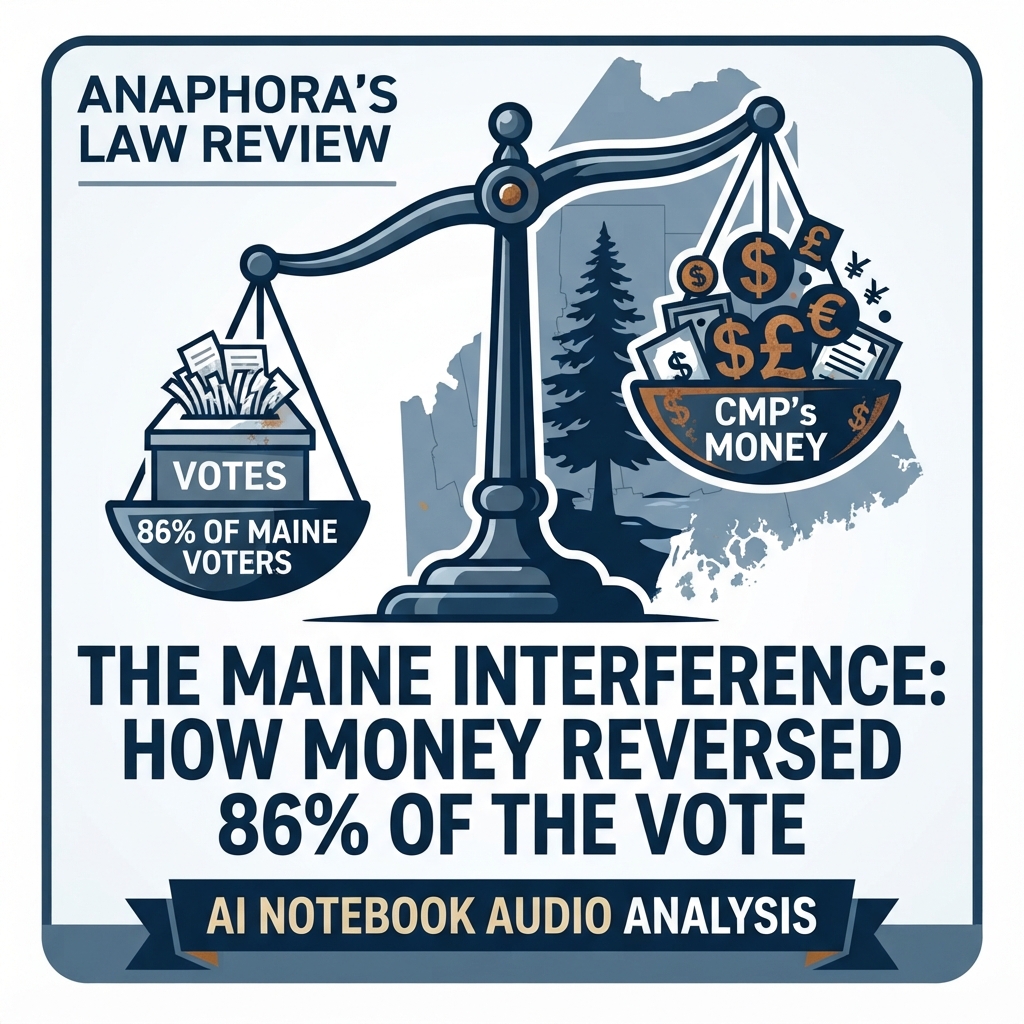
86% of Maine’s Voters Banned Foreign Election Interference, Before CMP’s Money Reversed Their Decision

24 Oct

In Central Maine Power Company (CMP), et al. v. Maine Commission on Governmental Ethics and Election Practices, et al., the United States District Court for the District of Maine granted motions to allow CMP to continue donating to political candidates by declaring two portions of Maine’s new campaign finance law unconstitutional, but denied motions regarding the remainder of the statute, allowing the rest of the law to survive through legal severance.

The first element the court objected to in the law is the 5% corporate foreign ownership rule, arguing that this was too small of a share, and that only a controlling shareholder should be significant enough to exclude a corporation’s influence over elections. The second point was over if a foreign government “directly or indirectly participates in the decision-making process” over elections spending. The court interpreted the latter as possibly merely meaning a foreign government had consulted a corporation, even if this corporation was fully owned by American shareholders.

According to OpenSecrets, CMP and its parent company Avangrid have largely spent money on ballot referendums. By donating over $35 million to the Maine Affordable Energy PAC, they defeated a referendum that would have forced a consumer buyout of the utility grid. And they spent tens of millions to defend their referendum for a hydropower transmission line through western Maine.

Maine passed a ballon initiative restricting Foreign Government-Influenced Entities (FGIE) back in 2023. The Act could apply a $5,000 civil penalty or double the amount donated. They could no longer spend on elections, and their public communications had to carry mandatory disclosures of foreign-influence. It also applied a new burden onto media companies to check if block ads that failed to meet these disclosure rules. Because of this lawsuit, this law was blocked on the eve it was going to go into effect. This stillborn law had passed by a historic 86% margin. The law had been led by the nonpartisan Protect Maine Elections, and democracy reform groups such as American Promise and Maine Clean Elections. And Free Speech for People and Campaign Legal Center have filed amicus briefs arguing the 5% limit is a globally recognized threshold. Though most democracies, such as France, Canada, Japan and South Korea, completely ban corporate political contributions: foreign and domestic. Thus, there limit is 0%. After the 2010 Supreme Court Citizens United ruling that allowed unlimited spending on elections by American corporations, U.S. states and cities have begun applying the 5% threshold to at least limit foreign spending.

Aside from Maine, there was also a failed attempt to implement foreign spending limits in Minnesota. The only state where a spending limit is currently being enforced is in Washington, which uses the controlling-share limit, as opposed to the 5% cutoff. The only places in the U.S. that have a 5% limit being enforced are the cities of Seatle (2020-) and San Jose (2024-).

Leading up to and after Citizens United, there has been systematic campaign to corrupt U.S. elections by arguing that corporations have a First Amendment right to “speak” with unlimited campaign contributions. Since the 2016 election of Donald Trump had been judged by oversight agencies to have been interfered in by foreign actors—especially Russia—this wave of attempts to counteract America’s slide into unbridled corruption could have given some hope, if it had not been repeatedly quashed by moneyed interests. Corporate donations had been banned in the U.S. by the 1907 Tillman Act. Because corporations reacted by attempting to donate indirectly, a few acts—between 1947 and 2002—followed that further limited activities, such as requiring that corporate employees could only donate indirectly into Political Action Committees (PACs). Citizens United reversed this march towards democratic representation. If CMP had not been able to block the Pine Tree Power buyout, Maine taxpayers would have taken on $13.5 billion in debt to buy the utility, but could have been rewarded with improved reliability and a lower electricity cost. And while the NECEC corridor added tons of energy to the grid, it clear-cut pristine northern Maine woods (undercutting tourism and wildlife) to bring power to Massachusetts. The point of democratic referendums is to invite voters to decide which among such choices they care most about. When 86% of Maine’s voters voted against foreign interference, and a corporation with these foreign influences could buy their way into winning a lawsuit to reverse the voters’ decision, this is an extreme case of anti-democratic voting-system suppression.

Suggested Citation:
Faktorovich, Anna. “86% of Maine’s Voters Banned Foreign Election Interference, Before CMP’s Money Reversed Their Decision.” Anaphora’s Law Review (October 24, 2026).