Tag Archives: democracy

Federal RICO Oversight of Teamsters Set to End

26 Oct

The latest decision in U.S.A. v. International Brotherhood of Teamsters, et al., U.S. District Judge Loretta A. Preska formally transitions the International Brotherhood of Teamsters (IBT) away from the preceding independent, court-ordered oversight and with a plan to return disciplinary control back to the union. Federal oversight commenced with a RICO lawsuit against IBT that established a consent decree in 1989. These restrictions began to be loosened in 2015 when the government seized direct involvement and put in place an outside oversight system. This 2026 order designs a plan to end oversight, claiming IBT is now free of mob corruption by having built a lasting democratically voting organization.

IBT has around 1.3 million active members across US and Canada, mostly in the delivery (UPS), transport (school buses), warehousing (Costco), civil service, airlines, railroads and food processing (Sysco) sectors.

There are now anti-mob injunctions, wherein IBT members must agree to avoid associating with a long list of barred individuals, such as La Cosa Nostra. The plan specifies that the role of the external Independent Investigations Officer (IIO) will be terminated on December 31, 2026, when their functions will transfer to IBT’s internal Office of Compliance Standards and Investigations (OCSI). Though federal judge Barbara S. Jones has been appointed to one more final three-year term as the Independent Review Officer (IRO) to oversee if the union is continuing to obey by anti-corruption mandates. And even after this three-year transition, IBT will continue to be overseen by an outside attorney with the title Independent Compliance Professional (ICP), who will sit on IBT’s Audit Committee.

The Department of Justice (DOJ) has had an interventionalist strategy against unions since the 80s. Aside for IBT, four other unions have been the subjects of federal lawsuits that have led to consent decreases for monitoring or government takeovers: International Longshoremen’s Association (ILA), Laborers’ International Union of North America (LIUNA), United Food and Commercial Workers (UFCW) and United Slate, Tile and Composition Roofers. Most of these oversight programs are coming to an end. In related litigation over IBT, there has been recent dissolution in Chicago, after 40 years of oversight, of Teamsters Central States Pension Fund. These attacks on the unions contributed to lowering the overall union membership rates in the US from around 18% in 1985 to 10% in 2025 (CEPR). Though a similar trend is seen internationally, as OECD reports developed nations’ union rates have dropped from 30% in 1985 to 15% in 2023. America is more sharply falling behind on collective bargaining coverage, as workers covered by collective agreements have fallen from 47% (1985) to 33.6% (2024), but in the US this number is down to 11.3%. There have been some similar to the US anti-corruption lawsuits elsewhere that have also installed government-overseers in unions, as with Australia’s compulsory state administration over its construction union CFMEU, and Canada’s trusteeship over its construction unions.

Union membership fees have increased in part to support the millions the federal government has been charging unions for their oversight. Though beyond these RICO litigations that have framed unions as corrupt, there have also been decisions such as Janus v. AFSCME at the Supreme Court that struck down mandatory agency fees for public employees that instantly halved memberships in public-sector unions.

There have been a few other non-governmental entities that have faced similar RICO scrutiny. In 2015, the football FIFA association was indicted by DOJ over accepting over $150 million in bribes to decide who would host its future championship. DOJ then placed its own monitor to oversee its operations to avoid similar corruption in the future. And DOJ filed RICO charges against SAC Capital Advisors ($14 billion in assets), thus forcing it to restructure and pay for a court-appointed compliance monitor in addition to paying $1.8 billion settlement. Back during Trump’s one failed presidential run, IBT’s General President Sean M. O’Brien made the then strange step of being the first Teamsters president ever to address the Republican National Convention (RNC). While O’Brien did not endorse Trump and focused his speech on corporate greed, by breaking the union’s prior exclusive relationship with the Democratic party (as by hosting events with Trump at Mar-a-Lago) O’Brien ingratiated himself to Trump’s administration sufficiently for the current continuation of the shift to liberate IBT from oversight.

Suggested Citation:
Faktorovich, Anna. “Federal RICO Oversight of Teamsters Set to End.” Anaphora’s Law Review (October 26, 2026).
86% of Maine’s Voters Banned Foreign Election Interference, Before CMP’s Money Reversed Their Decision

24 Oct

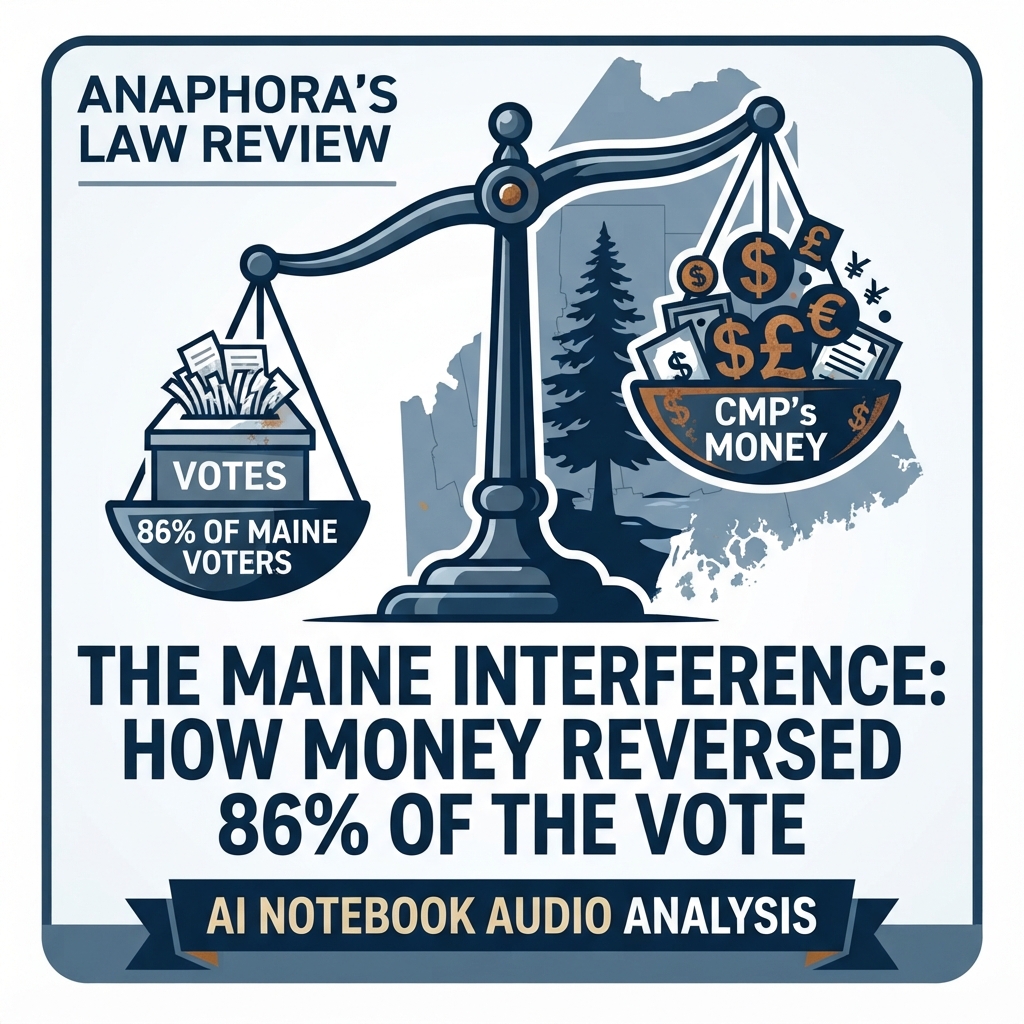
In Central Maine Power Company (CMP), et al. v. Maine Commission on Governmental Ethics and Election Practices, et al., the United States District Court for the District of Maine granted motions to allow CMP to continue donating to political candidates by declaring two portions of Maine’s new campaign finance law unconstitutional, but denied motions regarding the remainder of the statute, allowing the rest of the law to survive through legal severance.

The first element the court objected to in the law is the 5% corporate foreign ownership rule, arguing that this was too small of a share, and that only a controlling shareholder should be significant enough to exclude a corporation’s influence over elections. The second point was over if a foreign government “directly or indirectly participates in the decision-making process” over elections spending. The court interpreted the latter as possibly merely meaning a foreign government had consulted a corporation, even if this corporation was fully owned by American shareholders.

According to OpenSecrets, CMP and its parent company Avangrid have largely spent money on ballot referendums. By donating over $35 million to the Maine Affordable Energy PAC, they defeated a referendum that would have forced a consumer buyout of the utility grid. And they spent tens of millions to defend their referendum for a hydropower transmission line through western Maine.

Maine passed a ballon initiative restricting Foreign Government-Influenced Entities (FGIE) back in 2023. The Act could apply a $5,000 civil penalty or double the amount donated. They could no longer spend on elections, and their public communications had to carry mandatory disclosures of foreign-influence. It also applied a new burden onto media companies to check if block ads that failed to meet these disclosure rules. Because of this lawsuit, this law was blocked on the eve it was going to go into effect. This stillborn law had passed by a historic 86% margin. The law had been led by the nonpartisan Protect Maine Elections, and democracy reform groups such as American Promise and Maine Clean Elections. And Free Speech for People and Campaign Legal Center have filed amicus briefs arguing the 5% limit is a globally recognized threshold. Though most democracies, such as France, Canada, Japan and South Korea, completely ban corporate political contributions: foreign and domestic. Thus, there limit is 0%. After the 2010 Supreme Court Citizens United ruling that allowed unlimited spending on elections by American corporations, U.S. states and cities have begun applying the 5% threshold to at least limit foreign spending.

Aside from Maine, there was also a failed attempt to implement foreign spending limits in Minnesota. The only state where a spending limit is currently being enforced is in Washington, which uses the controlling-share limit, as opposed to the 5% cutoff. The only places in the U.S. that have a 5% limit being enforced are the cities of Seatle (2020-) and San Jose (2024-).

Leading up to and after Citizens United, there has been systematic campaign to corrupt U.S. elections by arguing that corporations have a First Amendment right to “speak” with unlimited campaign contributions. Since the 2016 election of Donald Trump had been judged by oversight agencies to have been interfered in by foreign actors—especially Russia—this wave of attempts to counteract America’s slide into unbridled corruption could have given some hope, if it had not been repeatedly quashed by moneyed interests. Corporate donations had been banned in the U.S. by the 1907 Tillman Act. Because corporations reacted by attempting to donate indirectly, a few acts—between 1947 and 2002—followed that further limited activities, such as requiring that corporate employees could only donate indirectly into Political Action Committees (PACs). Citizens United reversed this march towards democratic representation. If CMP had not been able to block the Pine Tree Power buyout, Maine taxpayers would have taken on $13.5 billion in debt to buy the utility, but could have been rewarded with improved reliability and a lower electricity cost. And while the NECEC corridor added tons of energy to the grid, it clear-cut pristine northern Maine woods (undercutting tourism and wildlife) to bring power to Massachusetts. The point of democratic referendums is to invite voters to decide which among such choices they care most about. When 86% of Maine’s voters voted against foreign interference, and a corporation with these foreign influences could buy their way into winning a lawsuit to reverse the voters’ decision, this is an extreme case of anti-democratic voting-system suppression.

Suggested Citation:
Faktorovich, Anna. “86% of Maine’s Voters Banned Foreign Election Interference, Before CMP’s Money Reversed Their Decision.” Anaphora’s Law Review (October 24, 2026).